
- 06/09/2026
- Simba Infotech
- 0
Introduction
In today’s digital-first world, mobile applications have become an essential tool for businesses looking to connect with customers, improve engagement, and drive growth. Whether you’re launching a startup, expanding an existing business, or creating a new digital service, understanding the mobile app development process is crucial for achieving success.
Mobile app development is more than just coding and design. It involves careful planning, research, testing, and ongoing maintenance to ensure the final product meets user expectations and business goals. In this guide, we’ll walk through the complete mobile app development process step by step.
1. Define Your Goals and Requirements
The first step in mobile app development is identifying the purpose of the app. Before any design or coding begins, businesses need to clearly define what they want the application to achieve.
Ask yourself questions such as:
- What problem will the app solve?
- Who is the target audience?
- What features are essential?
- What business objectives will the app support?
Having clear goals helps create a roadmap for the entire project and prevents unnecessary changes later in the development process.
2. Conduct Market Research
Market research plays a critical role in creating a successful mobile application. This stage involves analyzing competitors, understanding user behavior, and identifying market opportunities.
Research helps developers and businesses understand:
- Current industry trends
- User preferences
- Competitor strengths and weaknesses
- Potential gaps in the market
By gathering valuable insights, businesses can create an app that offers unique value and stands out from the competition.
3. Create a Detailed App Strategy
Once research is complete, the next step is building a comprehensive app strategy. This strategy outlines the app’s functionality, target users, revenue model, technology requirements, and project timeline.A well-defined strategy helps ensure that every decision aligns with business objectives and user expectations.
Important considerations include:
- Android, iOS, or cross-platform development
- Budget planning
- Feature prioritization
- Scalability requirements
- Security considerations
A strong strategy serves as the foundation for the entire development process.
4. Plan the App Features and Functionality

At this stage, developers and stakeholders collaborate to identify the key features the application will include.
Examples of common app features include:
- User registration and login
- Push notifications
- In-app messaging
- Payment gateways
- Search functionality
- User profiles
- Location tracking
It is often more effective to introduce core features first and expand the app over time. Many businesses launch a Minimum Viable Product (MVP) that contains essential features and then expand based on user feedback.
5. Create Wireframes and App Architecture
Wireframing is the process of creating a visual blueprint of the app’s structure. Wireframes help stakeholders understand how screens, navigation, and user interactions will function.
Benefits of wireframing include:
- Improved project clarity
- Better user flow planning
- Reduced development errors
- Faster decision-making
At the same time, developers design the app architecture, ensuring the backend systems, databases, and APIs are structured efficiently.This phase helps uncover potential usability challenges before the development process starts.
6. Design the User Interface (UI) and User Experience (UX)
A well-executed design is one of the key factors behind a successful mobile app. A visually appealing and user-friendly application encourages engagement and improves customer satisfaction.
UI design focuses on visual elements such as:
- Colors
- Typography
- Buttons
- Icons
- Layouts
UX design focuses on:
- Ease of navigation
- User interactions
- Accessibility
- Overall experience
A well-designed app should be intuitive, attractive, and easy to use across different devices.
7. Begin Mobile App Development
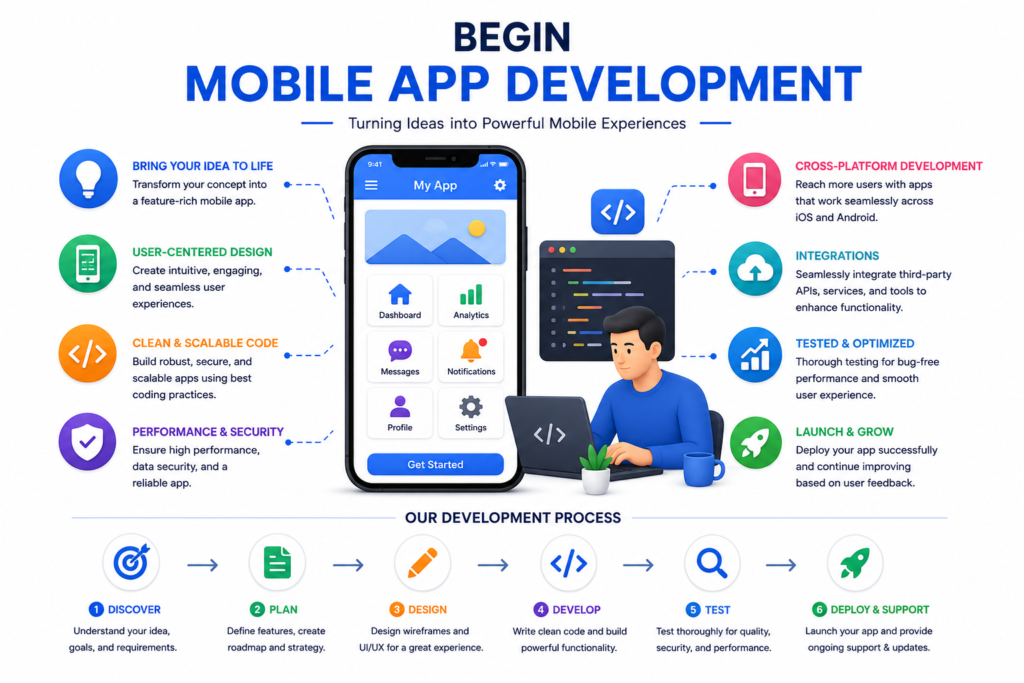
Once designs are approved, developers start building the application.
The development process is typically divided into two main areas:
- Frontend Development
This aspect of development focuses on designing and building the application’s user-facing components. This includes screens, buttons, forms, animations, and navigation.
- Backend Development
Backend development handles the server-side operations, including:
- Databases
- User authentication
- APIs
- Cloud services
- Data storage
Developers work together to ensure both frontend and backend systems communicate effectively and deliver a seamless user experience.
8. Integrate Third-Party Services
Many modern mobile applications rely on third-party tools and integrations to enhance functionality.
Common integrations include:
- Payment gateways
- Social media login
- Analytics platforms
- Mapping services
- Customer support tools
- Cloud storage solutions
These integrations can save development time while providing users with advanced features and capabilities.
9. Perform Comprehensive Testing
Testing is an essential stage in the mobile app development lifecycle. Even the most well-designed application can fail if bugs and performance issues are not addressed.
Several types of testing are performed, including:
- Functional Testing
- Ensures all app features work correctly.
- Performance Testing
Assesses the application’s speed, responsiveness, and stability across different operating conditions.
- Security Testing
Identifies vulnerabilities and protects user data.
- Compatibility Testing
Ensures the app functions properly across different devices, operating systems, and screen sizes.
- User Acceptance Testing (UAT)
- Enables real users to share feedback before the app is officially launched.
- Thorough testing helps improve quality and reduce the risk of post-launch issues.
10. Deploy the App to App Stores
After successful testing, the application is ready for launch.
The app is submitted to platforms such as:
- Google Play Store
- Apple App Store
Before submission, developers ensure compliance with store guidelines, optimize app descriptions, and prepare screenshots and promotional materials.
The application may undergo a review period before publication, with timelines varying by platform.
11. Monitor Performance After Launch
Launching an app marks the beginning of its ongoing improvement and maintenance journey. Continuous evaluation enables businesses to identify opportunities for optimization and growth.
Businesses should track important metrics such as:
- Downloads
- User retention
- Session duration
- Crash reports
- Customer feedback
- Conversion rates
Analytics tools provide valuable insights into user behavior and app performance.
12. Maintain and Update the Application
Regular maintenance is essential for keeping a mobile application secure, functional, and competitive.
Ongoing maintenance activities include:
- Bug fixes
- Security updates
- Performance improvements
- Feature enhancements
- Compatibility updates
As user needs evolve and technology changes, continuous updates help ensure long-term success.
Conclusion
The mobile app development process involves much more than writing code. From defining goals and conducting market research to designing, developing, testing, launching, andmaintaining the application, every stage plays a vital rolein delivering a successful product.
A structuredapproach helps businesses minimize risks, control costs, and create applications that provide real value to users.By following each step carefully, organizations can build mobile apps that enhance customer engagement, improve operational efficiency, and support long-term business growth.
As mobile technology continues to evolve, investing in a well-planned mobile app development process can give businesses a significant competitive advantage in today’s digital marketplace.
Frequently Asked Questions (FAQs)
1. What is the mobile app development process?
Ans: The mobile app development process is a structured approach that includes planning, market research, design, development, testing, deployment, and ongoing maintenance to create a successful mobile application.
2. How long does it take to develop a mobile app?
Ans: The development timeline depends on the app’s complexity, features, and platform requirements. A basic app may take a few months, while a more advanced application can take six months or longer.
3. Why is market research important before developing an app?
Ans: Market research helps businesses understand user needs, analyze competitors, identify trends, and discover opportunities to create a unique and valuable mobile application.
4. What is an MVP in mobile app development?
Ans: An MVP (Minimum Viable Product) is the initial version of an app that includes only the core features required to solve a problem and gather user feedback before further development.
5. What is the difference between UI and UX design?
Ans: UI (User Interface) design focuses on the visual appearance of the app, while UX (User Experience) design focuses on usability, navigation, and overall user satisfaction.
6. Why is app testing important?
Ans: Testing helps identify bugs, security vulnerabilities, performance issues, and compatibility problems, ensuring the app provides a smooth and reliable user experience.
7. Can a mobile app be developed for both Android and iOS?
Ans: Yes, businesses can choose cross-platform development frameworks that allow a single codebase to be used for both Android and iOS applications, reducing development time and costs.
8. What happens after a mobile app is launched?
Ans: After launch, businesses should monitor app performance, collect user feedback, fix bugs, release updates, and introduce new features to improve the app over time.
9. How often should a mobile app be updated?
Ans: Apps should be updated regularly to improve security, fix issues, enhance performance, and remain compatible with the latest operating system versions.
10. Why is ongoing app maintenance necessary?
Ans: Ongoing maintenance ensures the application remains secure, functional, and competitive while meeting evolving user expectations and technology standards.
Key Takeaways
- Mobile app development starts with clear business goals and user requirements.
- Market research helps identify opportunities, competitors, and user expectations.
- A strong app strategy ensures better planning, budgeting, and scalability.
- Prioritizing core features through an MVP can reduce risk and speed up launch.
- Wireframing and app architecture help create a smooth and efficient user experience.
- UI/UX design plays a major role in user engagement and customer satisfaction.
- Frontend and backend development work together to deliver seamless app functionality.
- Third-party integrations can enhance features while reducing development time.
- Comprehensive testing is essential for performance, security, and reliability.
- Successful deployment requires compliance with app store guidelines.
- Post-launch monitoring helps improve user retention and app performance.
- Regular maintenance and updates are critical for long-term success and competitiveness.