- 08/27/2026
- Simba Infotech
- 0
Introduction
Artificial Intelligence (AI) and Automation are transforming the way modern businesses operate, improve productivity, and deliver better customer experiences. Although these technologies are often mentioned together, they are not the same. Automation is designed to perform repetitive, rule-based tasks with minimal human involvement, while AI can learn from data, recognize patterns, and make intelligent decisions.
Understanding the difference between AI vs Automation is essential for choosing the right solution for your business goals. This is also exactly the kind of question the best digital marketing agency in Surat gets asked by clients every week. Whether you want to streamline daily operations, enhance customer service, or strengthen your digital marketing strategy, knowing how AI and Automation work can help you improve efficiency, reduce costs, and drive long-term business growth.
Understanding Artificial Intelligence (AI) and Automation
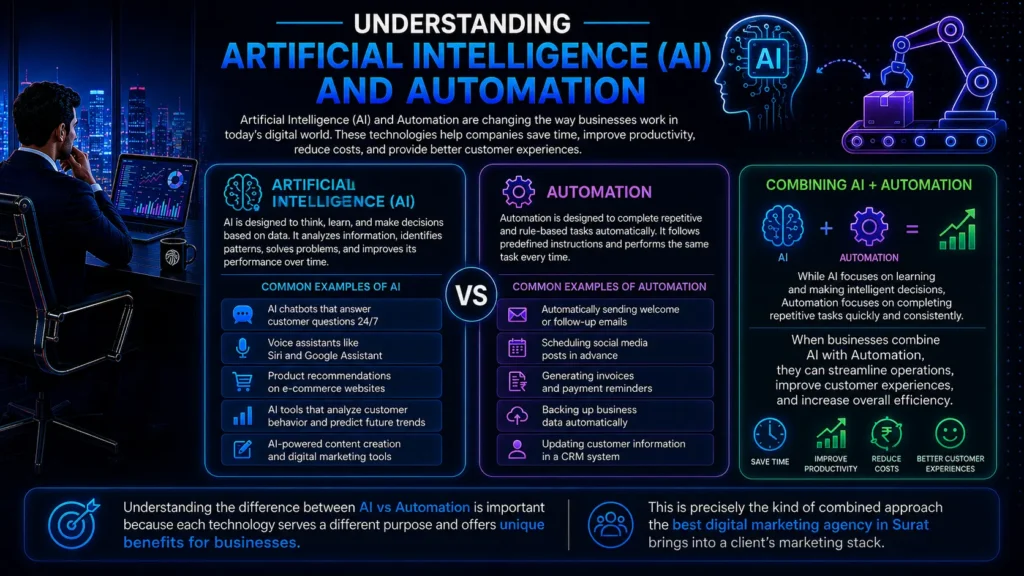
Artificial Intelligence (AI) and Automation are changing the way businesses work in today’s digital world. These technologies help companies save time, improve productivity, reduce costs, and provide better customer experiences. Although many people use the terms interchangeably, AI and Automation are not the same. Understanding the difference between AI vs Automation is important because each technology serves a different purpose and offers unique benefits for businesses.
Artificial Intelligence is designed to think, learn, and make decisions based on data. Instead of simply following fixed instructions, AI can analyze information, identify patterns, solve problems, and improve its performance over time. This makes AI useful for handling complex tasks that require intelligence and adaptability. Many businesses in Surat are now using AI to make smarter decisions and deliver more personalized services to their customers, often with guidance from the best digital marketing agency in Surat.
Some common examples of AI include:
- AI chatbots that answer customer questions 24/7
- Voice assistants like Siri and Google Assistant
- Product recommendations on e-commerce websites
- AI tools that analyze customer behavior and predict future trends
- AI-powered content creation and digital marketing tools
Automation, on the other hand, is designed to complete repetitive and rule-based tasks automatically. It follows predefined instructions and performs the same task every time without making its own decisions. Automation is ideal for reducing manual work, increasing accuracy, and saving valuable time.
Some common examples of Automation include:
- Automatically sending welcome or follow-up emails
- Scheduling social media posts in advance
- Generating invoices and payment reminders
- Backing up business data automatically
- Updating customer information in a CRM system
While AI focuses on learning and making intelligent decisions, Automation focuses on completing repetitive tasks quickly and consistently. When businesses combine AI with Automation, they can streamline operations, improve customer experiences, and increase overall efficiency. This is precisely the kind of combined approach the best digital marketing agency in Surat brings into a client’s marketing stack.
AI vs Automation: Understanding the Key Differences
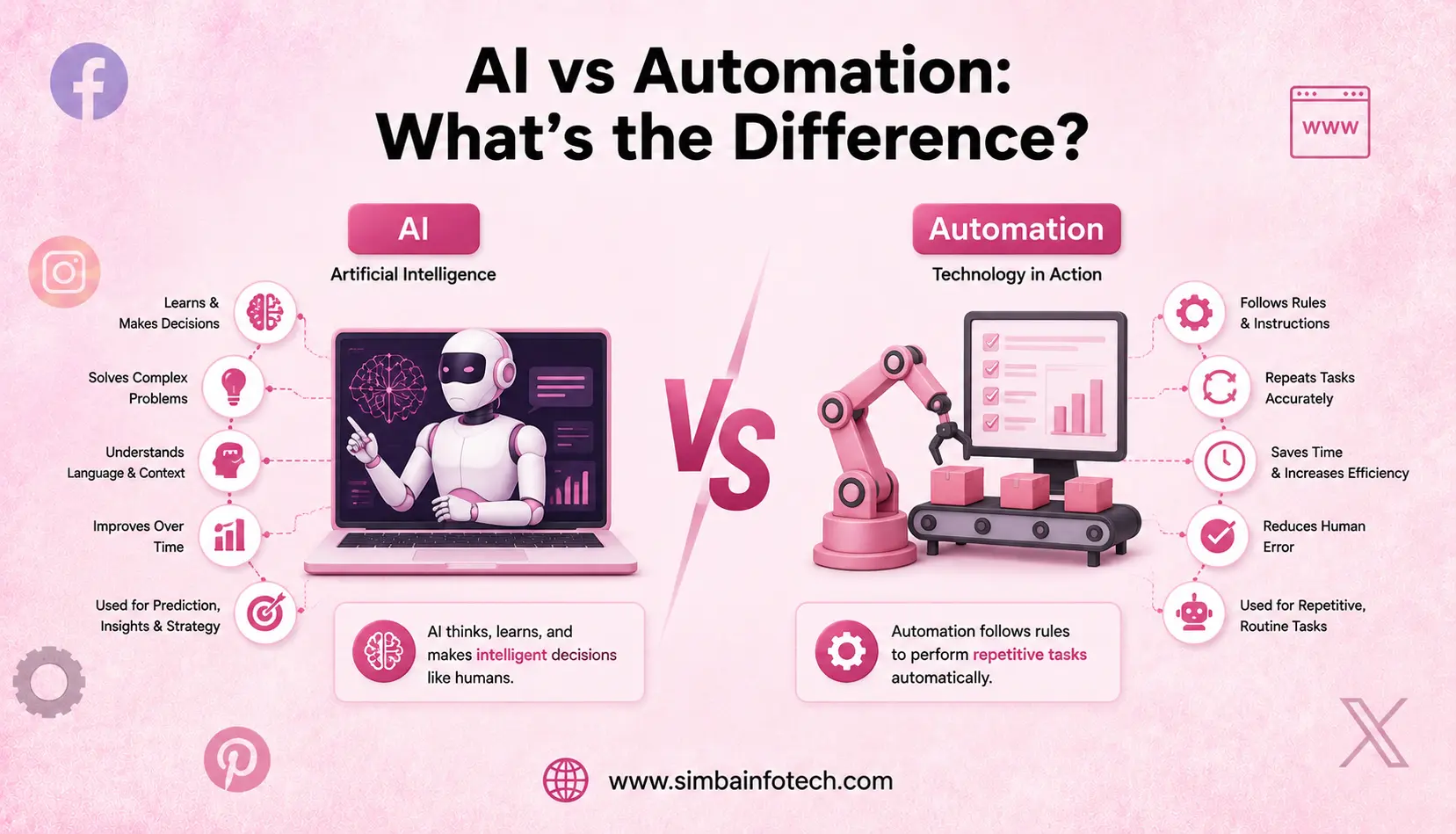
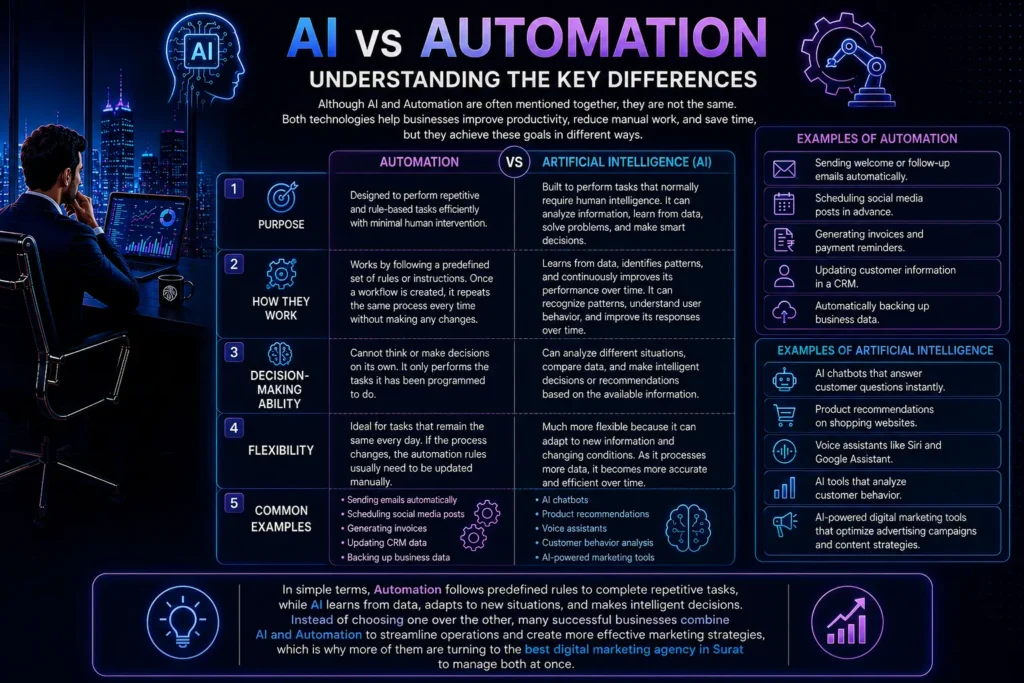
Although AI and Automation are often mentioned together, they are not the same. Both technologies help businesses improve productivity, reduce manual work, and save time, but they achieve these goals in different ways.
1. Purpose
Automation is designed to perform repetitive and rule-based tasks efficiently with minimal human intervention. Artificial Intelligence, however, is built to perform tasks that normally require human intelligence. It can analyze information, learn from data, solve problems, and make smart decisions based on the information it receives.
2. How They Work
Automation works by following a predefined set of rules or instructions. Once a workflow is created, it repeats the same process every time without making any changes. AI, in contrast, learns from data, identifies patterns, and continuously improves its performance over time. It can recognize patterns, understand user behavior, and improve its responses over time, making it much more flexible than traditional automation.
3. Decision-Making Ability
One of the key differences between AI and Automation lies in their decision-making capabilities. Automation cannot think or make decisions on its own. It only performs the tasks it has been programmed to do. AI can analyze different situations, compare data, and make intelligent decisions or recommendations based on the available information. This makes AI suitable for tasks that require problem-solving and data analysis.
4. Flexibility
Automation is ideal for tasks that remain the same every day. If the process changes, the automation rules usually need to be updated manually. AI is much more flexible because it can adapt to new information and changing conditions. As it processes more data, it becomes more accurate and efficient over time.
5. Common Examples
Understanding real-life examples makes the difference much easier to understand.
Examples of Automation:
- Sending welcome or follow-up emails automatically
- Scheduling social media posts in advance
- Generating invoices and payment reminders
- Updating customer information in a CRM
- Automatically backing up business data
Examples of Artificial Intelligence:
- AI chatbots that answer customer questions instantly
- Product recommendations on shopping websites
- Voice assistants like Siri and Google Assistant
- AI tools that analyze customer behavior
- AI-powered digital marketing tools that optimize advertising campaigns and content strategies
In simple terms, Automation follows predefined rules to complete repetitive tasks, while AI learns from data, adapts to new situations, and makes intelligent decisions. Instead of choosing one over the other, many successful businesses combine AI and Automation to streamline operations and create more effective marketing strategies, which is why more of them are turning to the best digital marketing agency in Surat to manage both at once.
How AI and Automation Work
Although AI and Automation often work together, they operate in different ways.
How Artificial Intelligence Works
Artificial Intelligence works by collecting and analyzing large amounts of data. It uses technologies such as Machine Learning (ML) and data analysis to identify patterns, learn from previous experiences, and make intelligent decisions. Unlike traditional software, AI continuously improves its performance as it processes more information.
For example, an AI chatbot can understand customer questions, provide relevant answers, and become more accurate over time. Similarly, AI tools can analyze customer behavior, predict future trends, and support smarter digital marketing campaigns.
AI follows this process:
- Collects data from different sources
- Analyzes the data to find patterns and insights
- Learns from previous interactions and results
- Makes intelligent decisions or recommendations
- Improves its performance through continuous learning
How Automation Works
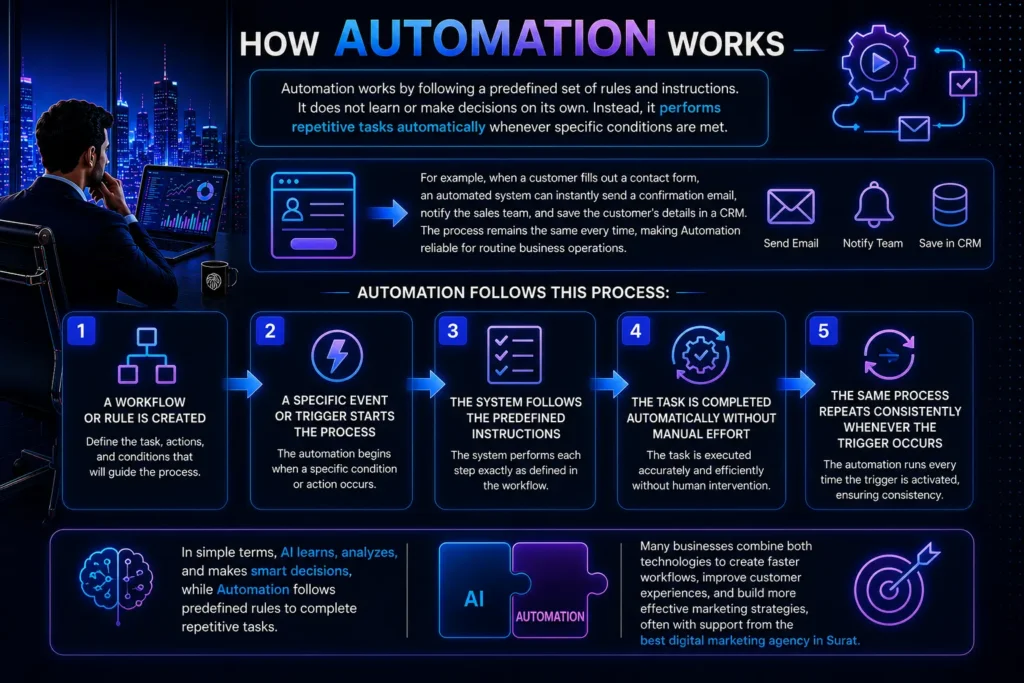
Automation works by following a predefined set of rules and instructions. It does not learn or make decisions on its own. Instead, it performs repetitive tasks automatically whenever specific conditions are met.
For example, when a customer fills out a contact form, an automated system can instantly send a confirmation email, notify the sales team, and save the customer’s details in a CRM. The process remains the same every time, making Automation reliable for routine business operations.
Automation follows this process:
- A workflow or rule is created
- A specific event or trigger starts the process
- The system follows the predefined instructions
- The task is completed automatically without manual effort
- The same process repeats consistently whenever the trigger occurs
In simple terms, AI learns, analyzes, and makes smart decisions, while Automation follows predefined rules to complete repetitive tasks. Many businesses combine both technologies to create faster workflows, improve customer experiences, and build more effective marketing strategies, often with support from the best digital marketing agency in Surat.
Benefits of AI and Automation for Businesses
AI and Automation are transforming the way businesses operate by improving efficiency, reducing manual work, and helping teams achieve better results.
Benefits of Artificial Intelligence
AI helps businesses make informed decisions by analyzing large amounts of data and identifying valuable insights. Key benefits include:
- Smarter decision-making through data analysis
- Personalized customer experiences based on behavior and preferences
- Improved customer support through AI-powered chatbots
- Predictive analytics for forecasting trends and demand
- Better digital marketing through optimized campaigns and content
- Continuous learning that improves accuracy over time
Benefits of Automation
Automation focuses on simplifying repetitive and time-consuming tasks, allowing employees to spend more time on important business activities. Key benefits include:
- Saving time on routine tasks
- Reducing human errors through consistent rule-following
- Increasing productivity by freeing up staff for strategic work
- Improving workflow efficiency and reducing delays
- Lowering operational costs
- Delivering consistent performance every time
Instead of choosing one over the other, many successful businesses combine AI and Automation to maximize efficiency and productivity. This is one of the reasons small and mid-sized businesses across Gujarat now look for the best digital marketing agency in Surat, since a good agency already understands how to combine both for real results.
AI vs Automation in Digital Marketing
AI and Automation are transforming the way businesses approach digital marketing. From attracting potential customers to converting them into loyal buyers, these technologies help marketers save time, improve campaign performance, and deliver personalized customer experiences.
How AI Helps in Digital Marketing
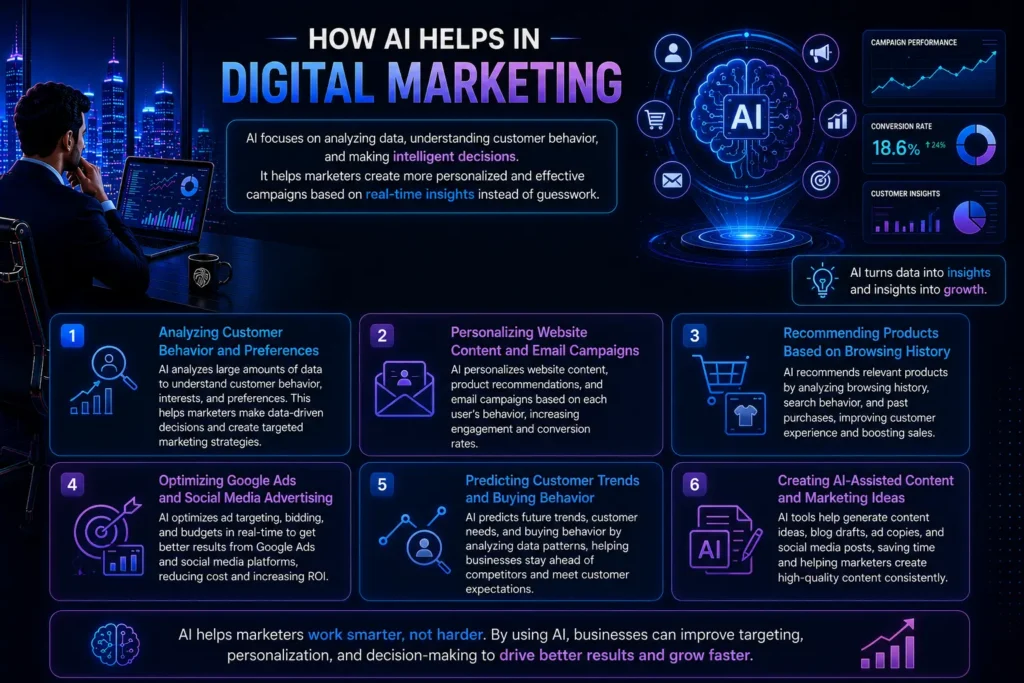
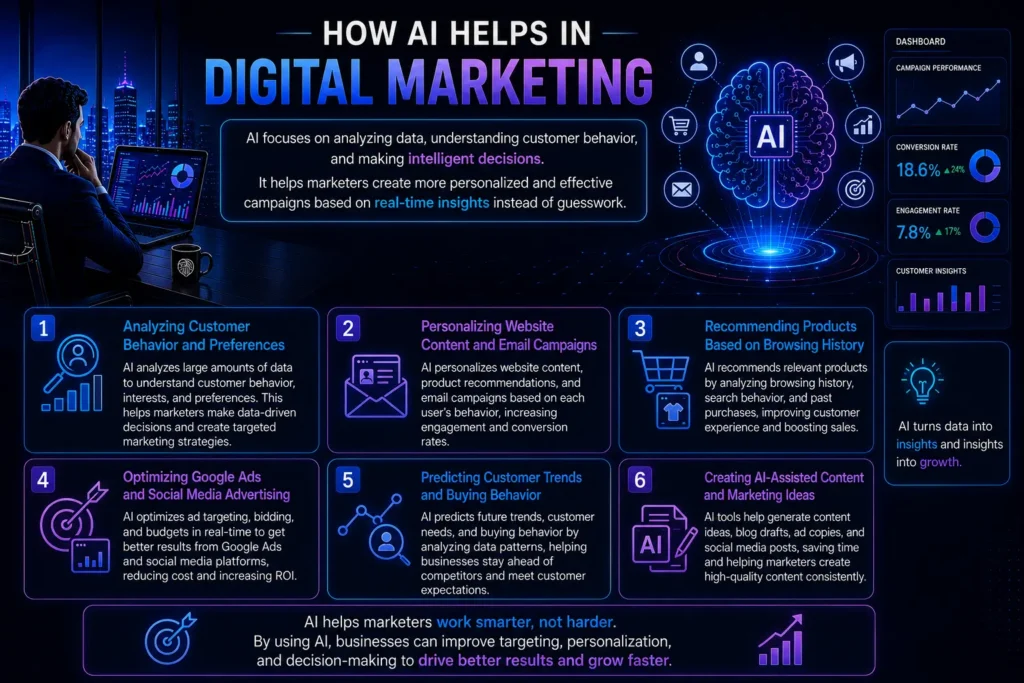
AI focuses on analyzing data, understanding customer behavior, and making intelligent decisions. It helps marketers create more personalized and effective campaigns based on real-time insights instead of guesswork. AI is commonly used for:
- Analyzing customer behavior and preferences
- Personalizing website content and email campaigns
- Recommending products based on browsing history
- Optimizing Google Ads and social media advertising
- Predicting customer trends and buying behavior
- Creating AI-assisted content and marketing ideas
How Automation Helps in Digital Marketing
Automation is designed to handle repetitive marketing tasks without requiring manual effort. It ensures that routine activities are completed on time and consistently. Automation is commonly used for:
- Scheduling social media posts
- Sending automated email campaigns
- Managing lead nurturing workflows
- Automatically responding to customer inquiries
- Publishing blogs and marketing content
- Updating customer information in CRM systems
Why Businesses Should Use Both
The most successful digital marketing strategies combine the power of AI and Automation. Automation takes care of repetitive tasks, while AI analyzes data and provides intelligent insights that improve marketing decisions. This exact combination is what separates an average freelancer from the best digital marketing agency in Surat, since an agency has the tools and the team to run both sides at once.
By using both technologies together, businesses can:
- Save time by automating routine marketing activities
- Deliver personalized experiences to customers
- Improve advertising performance and ROI
- Generate higher-quality leads
- Make faster, data-driven marketing decisions
- Increase customer engagement and conversions
Can AI Replace Automation?
The simple answer is no. AI cannot completely replace Automation because both technologies are designed for different purposes. Automation is best for handling repetitive, rule-based tasks such as sending emails, generating invoices, or updating customer records. AI, on the other hand, analyzes data, learns from experience, and makes intelligent decisions.
Instead of replacing Automation, AI makes it more powerful by adding intelligence to automated processes. When businesses combine AI and Automation, they can streamline operations, improve customer experiences, and enhance their digital marketing efforts.
When Should Your Business Choose AI or Automation?
Choosing between AI and Automation depends on your business goals, the type of tasks you want to improve, and the level of intelligence your processes require.
Choose AI When Your Business Needs To:
- Analyze large amounts of customer or business data
- Predict customer behavior and future market trends
- Personalize product recommendations and marketing campaigns
- Improve customer support with AI-powered chatbots
- Make data-driven business decisions
- Enhance your digital marketing strategy using customer insights and campaign optimization
Choose Automation When Your Business Needs To:
- Automate repetitive daily tasks
- Send emails, invoices, and reminders automatically
- Schedule social media posts in advance
- Manage lead follow-ups and CRM updates
- Reduce manual errors and save employee time
- Create faster and more consistent business workflows
If your goal is to think smarter, choose AI. If your goal is to work faster, choose Automation. However, many businesses achieve the best results by combining both, which is exactly why more owners are searching for the best digital marketing agency in Surat instead of trying to piece together separate tools on their own.
Can AI and Automation Work Together?
Yes, and this combination is helping businesses become more efficient and productive. Automation handles repetitive tasks such as sending emails, updating customer records, and managing workflows, while AI adds intelligence by analyzing data, making predictions, and supporting better decision-making.
Businesses can use both technologies to:
- Automate routine tasks with minimal manual effort
- Deliver personalized customer experiences
- Improve customer support using AI-powered chatbots
- Optimize digital marketing campaigns with data-driven insights
- Increase productivity while reducing operational costs
By using AI and Automation together, businesses can streamline daily operations, make smarter decisions, and deliver better customer experiences, giving them a competitive advantage in today’s digital world.
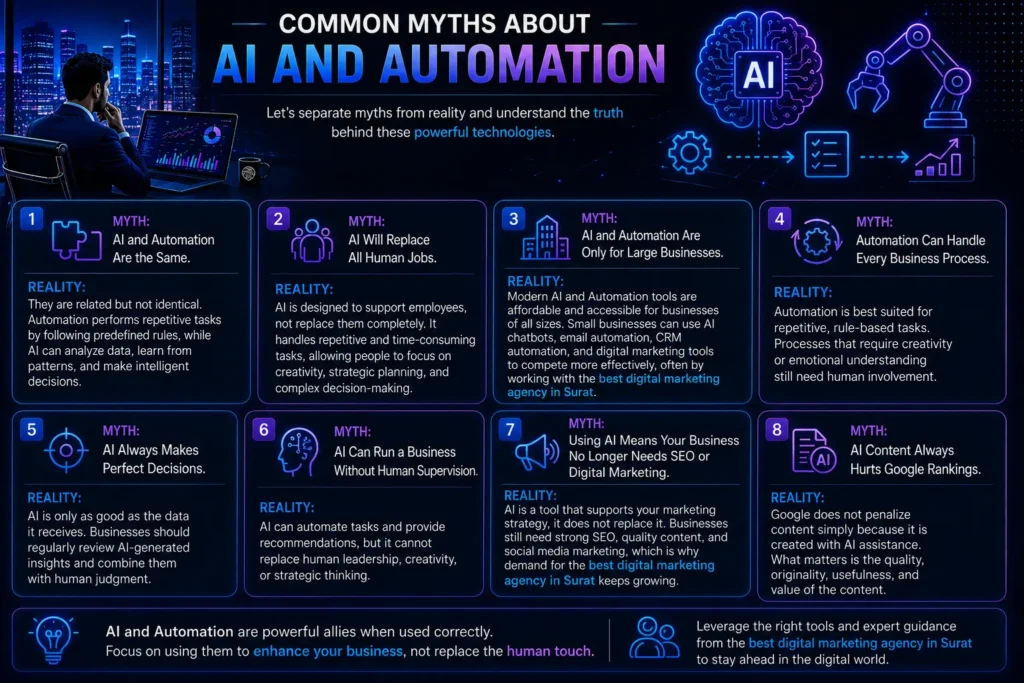
Common Myths About AI and Automation
Myth 1: AI and Automation Are the Same. Reality: they are related but not identical. Automation performs repetitive tasks by following predefined rules, while AI can analyze data, learn from patterns, and make intelligent decisions.
Myth 2: AI Will Replace All Human Jobs. Reality: AI is designed to support employees, not replace them completely. It handles repetitive and time-consuming tasks, allowing people to focus on creativity, strategic planning, and complex decision-making.
Myth 3: AI and Automation Are Only for Large Businesses. Reality: modern AI and Automation tools are affordable and accessible for businesses of all sizes. Small businesses can use AI chatbots, email automation, CRM automation, and digital marketing tools to compete more effectively, often by working with the best digital marketing agency in Surat rather than building everything in house.
Myth 4: Automation Can Handle Every Business Process. Reality: Automation is best suited for repetitive, rule-based tasks. Processes that require creativity or emotional understanding still need human involvement.
Myth 5: AI Always Makes Perfect Decisions. Reality: AI is only as good as the data it receives. Businesses should regularly review AI-generated insights and combine them with human judgment.
Myth 6: AI Can Run a Business Without Human Supervision. Reality: AI can automate tasks and provide recommendations, but it cannot replace human leadership, creativity, or strategic thinking.
Myth 7: Using AI Means Your Business No Longer Needs SEO or Digital Marketing. Reality: many businesses believe AI can automatically generate traffic and sales without any marketing effort. In reality, AI is a tool that supports your marketing strategy, it does not replace it. Businesses still need strong SEO, quality content, and social media marketing, which is why demand for the best digital marketing agency in Surat keeps growing rather than shrinking.
Myth 8: AI Content Always Hurts Google Rankings. Reality: Google does not penalize content simply because it is created with AI assistance. What matters is the quality, originality, usefulness, and value of the content.
Future of AI and Automation
AI and Automation are evolving rapidly, and their role in business will continue to expand in the coming years.
- AI will become more intelligent, better understanding human language and providing more accurate recommendations
- Hyperautomation will become common, combining AI, Automation, and analytics to automate entire workflows
- Human-AI collaboration will increase, with AI handling repetitive tasks while humans focus on creativity and strategy
- Personalization will reach a new level, with AI understanding customer preferences and predicting needs in real time
- Digital marketing will get smarter, with AI helping businesses create better content and identify the right audience
- Industry-wide adoption will continue across healthcare, education, finance, retail, and logistics
As these tools grow more common, businesses will also need to focus on protecting customer data, using AI responsibly, and training employees to work with AI-powered tools. Many owners find it easier to keep pace by partnering with the best digital marketing agency in Surat rather than tracking every new tool themselves.
Conclusion
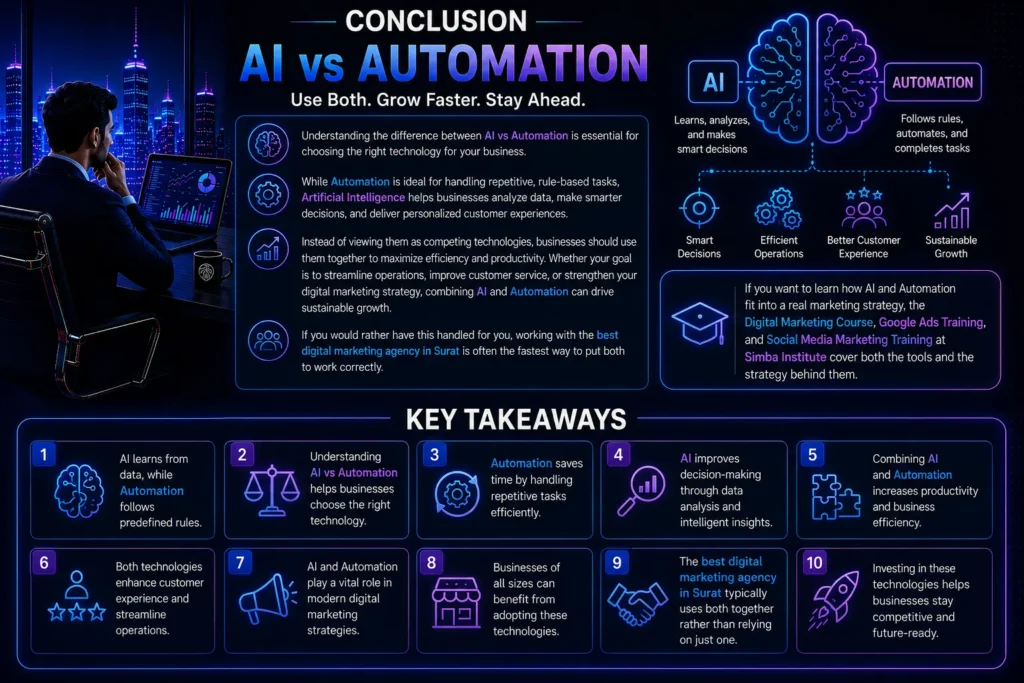
Understanding the difference between AI vs Automation is essential for choosing the right technology for your business. While Automation is ideal for handling repetitive, rule-based tasks, Artificial Intelligence helps businesses analyze data, make smarter decisions, and deliver personalized customer experiences.
Instead of viewing them as competing technologies, businesses should use them together to maximize efficiency and productivity. Whether your goal is to streamline operations, improve customer service, or strengthen your digital marketing strategy, combining AI and Automation can drive sustainable growth. If you would rather have this handled for you, working with the best digital marketing agency in Surat is often the fastest way to put both to work correctly.
If you want to learn how AI and Automation fit into a real marketing strategy, the Digital Marketing Course, Google Ads Training, and Social Media Marketing Training at Simba Institute cover both the tools and the strategy behind them.
Key Takeaways
- AI learns from data, while Automation follows predefined rules
- Understanding AI vs Automation helps businesses choose the right technology
- Automation saves time by handling repetitive tasks efficiently
- AI improves decision-making through data analysis and intelligent insights
- Combining AI and Automation increases productivity and business efficiency
- Both technologies enhance customer experience and streamline operations
- AI and Automation play a vital role in modern digital marketing strategies
- Businesses of all sizes can benefit from adopting these technologies
- The best digital marketing agency in Surat typically uses both together rather than relying on just one
- Investing in these technologies helps businesses stay competitive and future-ready