
- 06/06/2026
- Simba Infotech
- 0
Introduction
Marketing is everywhere.
Every day, businesses run Google Ads campaigns, invest in SEO, work with a digital marketing agency, hire social media marketing agencies, and spend money on online advertising to attract customers. Modern marketing feels fast, data-driven, and incredibly sophisticated.
Yet if you went back a hundred years and told a business owner that one day companies would use artificial intelligence to predict customer behavior, track millions of clicks, and personalize advertisements for individual users, they would probably think you were describing science fiction.
But marketing did not always look like this.
There was a time when businesses did not need websites, social media, search engines, or performance marketing agencies. There was no Google Ads platform. There were no ecommerce marketing agencies. In fact, there was no internet at all. Many companies grew simply by making products and making them available to customers.
Back then, marketing was much simpler. Or at least it seemed simpler.
If you made a decent product and got it in front of people, chances were good that customers would buy it. Competition was lower, information traveled slowly, and consumers had far fewer choices than they do today.
However, markets rarely stay simple for long.
As industries grew, competitors appeared. Customers gained more options. Products became similar. Businesses could no longer rely only on manufacturing or distribution to win. They needed new ways to attract attention and persuade customers.
And so marketing evolved. Then something even more interesting happened. As, the more marketers learned about customers, the more they realized how little they actually understood them. At first, businesses believed customers bought the best products.
Then they discovered that customers often bought the products they remembered. Later, they learned that customers trusted brands more than products. Then psychologists and economists showed that customers were not nearly as rational as marketers assumed. Suddenly, marketing was no longer just about products, pricing, and promotion. It became about perception and trust and also about the physcology.
And today, with artificial intelligence, automation, behavioral data, and Marketing 5.0, marketing is changing once again.
So before we begin, a small warning.
This journey will take us across more than a century of marketing history. We will meet economists, advertisers, psychologists, brand builders, and even a few Nobel Prize winners along the way. We will travel from factories and newspaper advertisements to AI algorithms and personalized customer experiences.
Fortunately, this is much more interesting than it sounds. Because the evolution of marketing is not really the story of advertising. It is the story of how businesses gradually learned to understand people.
Along the way, we will explore the ideas of Philip Kotler, David Aaker, Daniel Kahneman, Richard Thaler, and many others who changed the way businesses think about customers. We will also see how these ideas continue to influence modern SEO, Google Ads, social media marketing, ecommerce marketing agencies, performance marketing agencies, and nearly every digital marketing agency operating today.
So fasten your seatbelt.
We are about to travel through more than a hundred years of marketing history to understand how marketing evolved from selling products to understanding people—and perhaps where it is heading next.
What Is the Evolution of Marketing?
The evolution of marketing refers to the way marketing ideas, strategies, and practices have changed over time.
At first glance, marketing may seem like advertising. Many people think marketing is simply running ads, posting on social media, improving SEO, launching Google Ads campaigns, or working with a digital marketing agency.
But marketing is much broader than that.
Marketing is how businesses create value, communicate value, and persuade customers to choose them over alternatives.
One of the people most responsible for shaping modern marketing, Philip Kotler, defined marketing as the process through which organizations create value for customers and build strong customer relationships in order to capture value in return. While that sounds simple, it completely changed how businesses thought about growth.
Before marketing became a formal discipline, many companies focused almost entirely on products. If a business could manufacture a product efficiently and distribute it widely, success often followed. There was little need to think deeply about customer psychology, branding, positioning, or behavioral economics because markets looked very different from the way they do today.
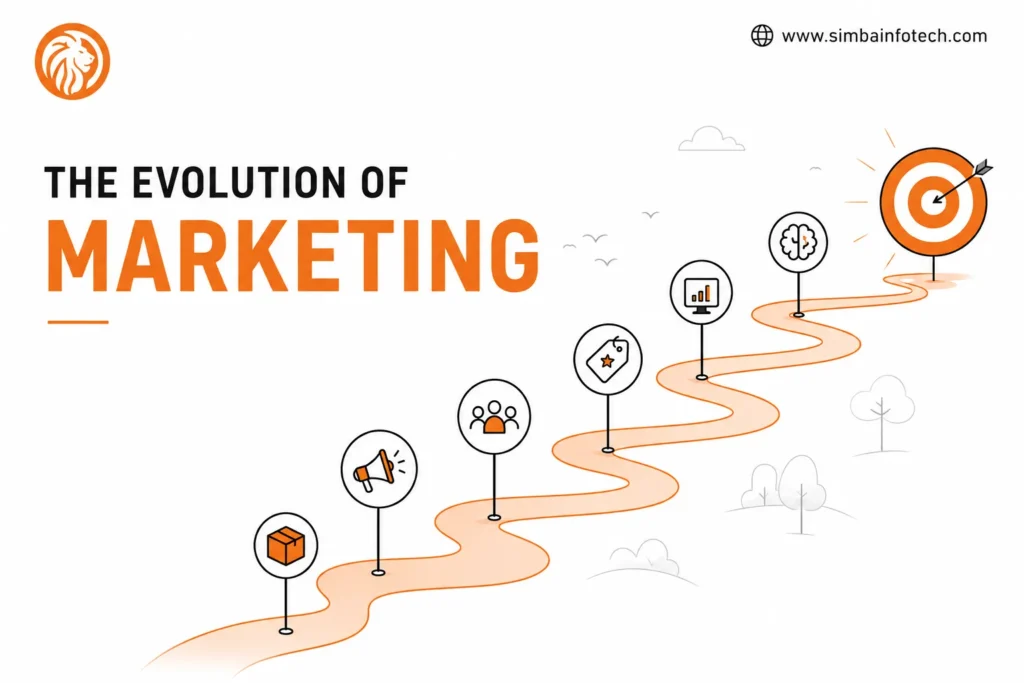
To understand why marketing evolved, we first need to understand the world in which early businesses operated. Imagine buying a product one hundred years ago. The experience would be completely different from what we know today.
There was no Google to instantly answer questions, no online reviews to reveal what other customers thought, no comparison websites to help evaluate alternatives, and certainly no e-commerce marketing agencies helping brands optimize every step of the customer journey. Information was limited, and obtaining it often required significant time and effort.
In many cases, customers had access to only a handful of options. Local businesses faced limited competition because transportation and communication networks were not as advanced as they are today. Most products were difficult to compare, and consumers often relied on word-of-mouth recommendations, newspaper advertisements, or the reputation of local merchants when making purchasing decisions. As a result, buying a product was usually a much simpler process. If you needed a particular item and only one company sold it nearby, there was a strong chance that you would purchase it without spending hours researching alternatives.
Today, however, the situation is completely different. Customers can compare hundreds of products within minutes.
They can watch demonstration videos, read customer reviews, compare prices across multiple websites, check ratings, browse social media discussions, and research alternatives before making a decision. Businesses no longer compete only with companies in their local area; they often compete with brands from across the country or even around the world. A small business can suddenly find itself competing against global corporations, while consumers have more choices than at any other point in history.
This dramatic increase in choice has created challenges that marketers in the past rarely faced. Attention has become one of the most valuable resources in the modern economy because customers are constantly exposed to advertisements, content, notifications, and competing messages.
Trust has also become harder to earn because consumers are naturally skeptical of marketing claims and have access to countless sources of information. At the same time, standing out has become increasingly difficult because many products offer similar features, benefits, and pricing.
This is why the evolution of marketing is so important. It is not simply a story about advertising channels changing from newspapers to radio, from radio to television, and from television to social media. Rather, it is the story of how businesses continuously adapted to changing customer expectations, new technologies, and increasingly competitive markets. Every major stage in marketing history emerged because the previous approach was no longer sufficient to solve the challenges businesses faced.
For example, when products became increasingly similar, marketers realized that being better was not always enough. Customers needed a reason to remember a brand, which led to the development of positioning strategies popularized by thinkers such as Al Ries and Jack Trout. Later, when positioning alone could not fully explain why customers preferred certain companies, marketers turned their attention to branding. Experts such as David Aaker demonstrated that strong brands create trust, emotional connections, and long-term value that extend far beyond the products themselves.
As research into consumer behavior expanded, marketers discovered something even more surprising: customers were not always rational decision-makers. Behavioral economists and psychologists such as Daniel Kahneman and Richard Thaler showed that people are influenced by cognitive biases, emotions, mental shortcuts, and contextual factors that often shape decisions without conscious awareness. These discoveries transformed marketing by helping businesses understand not only what customers buy but also why they buy it.
The arrival of digital technology accelerated this evolution even further. Search engines, websites, social media platforms, and mobile devices fundamentally changed how businesses communicate with customers. New disciplines such as SEO, content marketing, social media marketing, performance marketing, and online advertising emerged, creating opportunities for digital marketing agencies, social media marketing agencies, online advertising agencies, and countless marketing professionals around the world.
Today, we are entering yet another phase of marketing evolution driven by artificial intelligence, automation, predictive analytics, personalization, and Marketing 5.0. Businesses can now analyze enormous amounts of customer data, automate marketing campaigns, and deliver highly personalized experiences at a scale that would have seemed impossible just a few decades ago.
What makes this journey so fascinating is that marketing never truly stops evolving. Every generation of marketers believes it has finally figured customers out, only to discover that customer behavior continues to change. New technologies emerge, competitive landscapes shift, consumer expectations rise, and fresh insights challenge long-held assumptions. As a result, marketing constantly reinvents itself to keep pace with the world around it.
The evolution of marketing is therefore not just the history of business. It is the history of how businesses learned to understand people.
How Did the Evolution of Marketing Begin in the Product Era?
Lorem ipsum dolor sit amet, consectetur adipiscing elit. Ut elit tellus, luctus nec ullamcorper mattis, pulvinar dapibu
The story of marketing did not begin with advertisements, social media campaigns, or clever brand slogans. It began in factories.
The earliest stage in the evolution of marketing is known as the Product Era, sometimes called the Production Era. To truly understand this period, we need to step back into a world that looked completely different from the one we live in today. There were no websites, no Google searches, no Facebook ads, and no influencers promoting products online. In fact, many of the communication channels that businesses rely on today simply did not exist.
s leo.

During the late nineteenth and early twentieth centuries, the world was experiencing rapid industrial growth. New inventions, improved machinery, and advances in transportation were transforming economies.
Factories could now produce goods on a scale that had never been possible before. Railroads connected cities, steamships expanded trade routes, and manufacturing became faster and more efficient.
However, businesses faced a challenge that might seem unusual by today’s standards. Their biggest problem was not finding customers. It was producing enough products to satisfy demand.
Consumers wanted household goods, clothing, tools, transportation, and other products that were becoming available for the first time to larger portions of society. Demand often exceeded supply, meaning businesses could sell almost everything they produced. If a company could manufacture a reliable product and get it into stores, customers would usually buy it without much persuasion.
Because of this environment, companies focused almost entirely on production. Success was measured by how efficiently a business could manufacture goods, lower costs, improve distribution, and increase output. Marketing, as we think of it today, played only a minor role because there was little need to convince customers to buy something that was already difficult to obtain.
This period gave rise to a simple but powerful business philosophy:
“If we build a good product, customers will buy it.”
For many companies, this belief was completely logical. Competition was limited, markets were growing rapidly, and consumers had relatively few alternatives. Businesses assumed that superior products and efficient production would naturally lead to sales.
One of the most famous examples of this mindset can be seen in the success of Henry Ford and the Ford Model T.
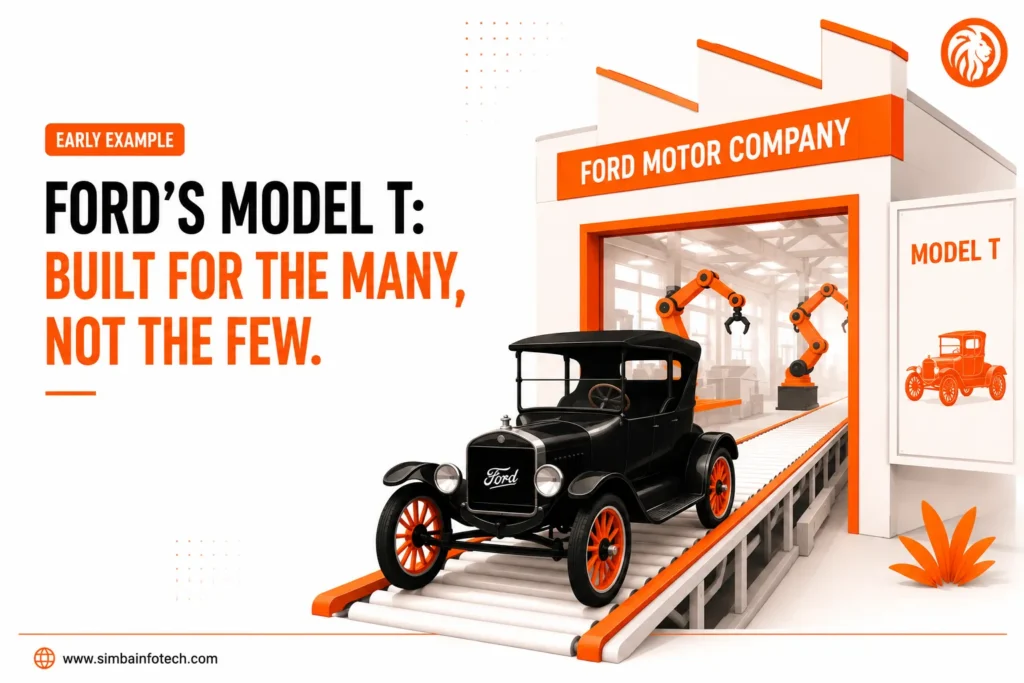
Before Ford, automobiles were expensive luxury items that only wealthy individuals could afford. Ford changed everything by introducing the moving assembly line, a manufacturing innovation that dramatically reduced production time and costs. Instead of focusing on sophisticated advertising campaigns, Ford concentrated on making cars affordable, reliable, and accessible to ordinary people.
The results were extraordinary. The price of automobiles dropped significantly, production increased dramatically, and millions of people were able to own a car for the first time. Ford’s success wasn’t driven by persuasive marketing messages. It was driven by production efficiency.
His famous quote perfectly captures the spirit of the Product Era:
“Any customer can have a car painted any color that he wants so long as it is black.”
While often repeated as a joke, the quote reveals a deeper truth about how businesses thought at the time. Companies believed that standardization and efficiency were more important than customization. Customers were expected to adapt to the product rather than businesses adapting to customer preferences.
Ford was not alone in this approach. Many manufacturers followed similar principles. Companies producing sewing machines, agricultural equipment, canned foods, and household goods focused primarily on making products faster, cheaper, and more widely available. The assumption was simple: if demand remained high, production would determine success.
Another example can be found in the consumer goods industry. Early manufacturers of soap, flour, and packaged foods invested heavily in factories and distribution networks. Their goal was not to differentiate their brands through emotional storytelling but to ensure their products could reach more households than competitors.
For a time, this strategy worked exceptionally well.
As industrialization spread across countries and production capabilities improved, businesses experienced tremendous growth. Entire industries expanded because consumers finally had access to products that were once considered luxuries. Manufacturing became the engine of economic progress, and product availability became a symbol of modern life.
However, success created a new challenge.
As more companies entered the market, competition increased. Manufacturing techniques became easier to replicate, production costs fell, and similar products began appearing everywhere. Customers suddenly had more options than ever before.
A company that once dominated simply because it could produce efficiently now faced competitors offering nearly identical products. Businesses slowly discovered that making a good product was no longer enough.
For the first time, companies had to think beyond the factory floor.
Instead of asking, “How can we make more products?” they began asking a much more important question:
“Why should customers choose our product instead of someone else’s?”
This shift marked one of the most important turning points in business history. Companies started paying closer attention to customer preferences, product differentiation, sales techniques, and persuasion.
The Product Era had laid the foundation for modern business by proving the importance of quality, efficiency, and innovation. But as competition intensified, a new reality emerged: success would no longer be determined solely by what companies could produce.
It would increasingly be determined by how well they understood their customers.
That realization would eventually lead businesses into the next chapter of marketing history—the Sales Era, where persuasion and selling became just as important as production itself.
How Did the Evolution of Marketing Move into the Sales Era?
As competition increased, businesses faced a problem they had never encountered before.
Products were no longer selling automatically.
Factories had become more efficient, production had increased, and many industries could now manufacture more goods than customers immediately needed. For the first time, supply started catching up with demand.
This changed everything.
Businesses could no longer assume that customers would simply buy whatever they produced. Instead, they had to convince people to choose their products over competing alternatives.
As a result, selling became a major focus.
During the Sales Era, businesses believed that customers needed persuasion before making a purchase. Advertising became more common, sales teams expanded, and companies invested heavily in promotional activities. The goal was no longer just producing products. The goal was selling products.
This period also gave rise to some of the most influential advertising pioneers in history.
One of the earliest was Claude Hopkins and David Ogilvy, often considered one of the fathers of modern advertising. Hopkins believed advertising should be measured by results rather than creativity alone. His famous book Scientific Advertising introduced ideas such as testing, coupons, and tracking responses—concepts that modern digital marketers still use today through SEO, Google Ads, and performance marketing.
Another important figure was Albert Lasker, sometimes called the father of modern advertising. Lasker helped popularize the idea that advertising should function as “salesmanship in print.” In other words, advertisements should not simply inform people. They should persuade people to take action.
As radio, newspapers, magazines, and later television became more popular, advertising started reaching audiences at a scale never seen before. Brands began competing not only through product features but through messages, stories, and persuasion.
Later, one of the most famous figures in advertising history emerged: David Ogilvy.
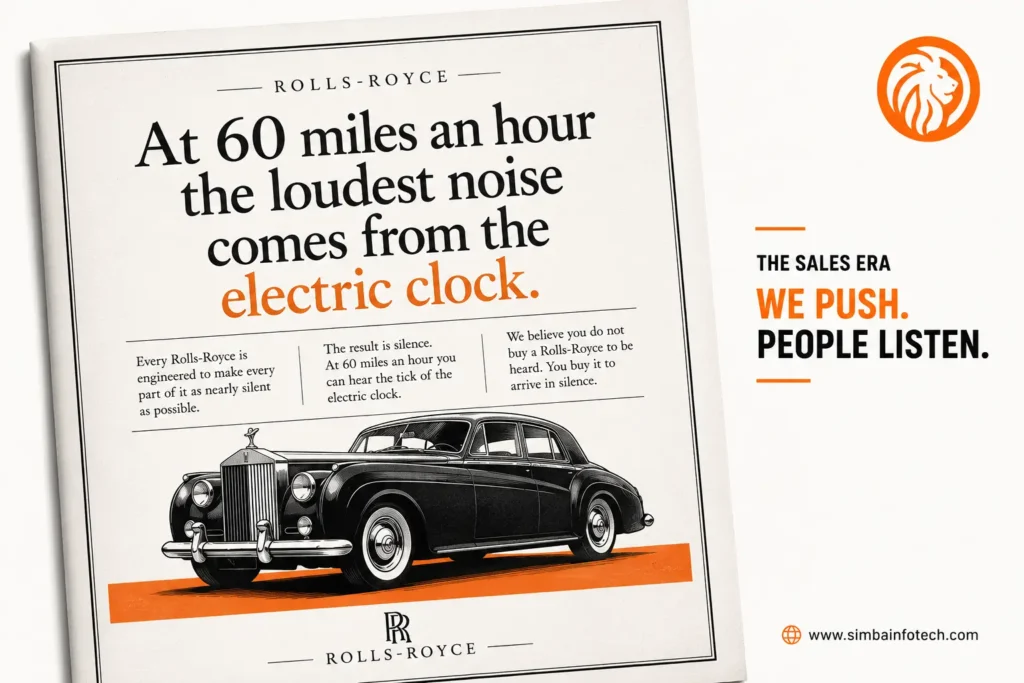
Often called the “Father of Advertising,” Ogilvy believed that consumers were intelligent and should be treated with respect. His campaigns combined research, psychology, and strong copywriting. Some of his advertisements became legendary, including the famous Rolls-Royce headline:
“At 60 miles an hour the loudest noise in this new Rolls-Royce comes from the electric clock.”
The advertisement did not simply describe the car. It communicated quality, engineering excellence, and luxury through a single memorable idea.
Ogilvy’s work demonstrated an important lesson. Successful advertising was not about shouting louder than competitors. It was about understanding what customers cared about and presenting it in a compelling way.
The dominant belief of the Sales Era was simple:
“Customers will not buy enough unless we actively persuade them.”
And for a time, this approach worked remarkably well.
However, the Sales Era eventually created a new problem. As more businesses adopted advertising and sales techniques, customers became exposed to increasing amounts of persuasion. Companies were becoming better at selling, but many were still not asking an important question:
What do customers actually want?
A company could have the best salespeople, the biggest advertising budget, and the most persuasive advertisements. Yet if it failed to understand customer needs, long-term growth remained difficult.
Slowly, businesses began to realize that persuasion alone was not enough.
Instead of asking:
“How do we sell more products?”
They started asking:
“How do we create value for customers?”
This shift would become one of the most important turning points in the evolution of marketing and would later be formalized by Philip Kotler and the Marketing Concept Era.
How Did Philip Kotler and the Marketing Concept Era Change the Evolution of Marketing?
By the middle of the twentieth century, businesses were becoming very good at producing products and very good at selling them. Yet many companies were still facing a problem.
Customers had more choices than ever before. With this competition rising and many new products flooding the market, it has become harder for businesses to push and sell their products aggressively.
Businesses slowly realized that success did not come from simply producing products or persuading people to buy them. Success came from understanding what customers actually wanted in the first place.
This marked the beginning of what became known as the Marketing Concept Era.
Instead of asking: “How do we sell what we make?” Businesses started asking: “What should we make?”

While that may sound like a small difference, it completely changed how companies approached marketing.
One of the people most responsible for shaping this new way of thinking was Philip Kotler, often called the Father of Modern Marketing.
Kotler helped transform marketing from a collection of business activities into a formal discipline. Rather than viewing marketing as advertising or selling, he argued that marketing should begin with understanding customer needs and creating value.
His famous definition described marketing as the process by which organizations create value for customers and build strong customer relationships to capture value in return.
This idea shifted the focus of business away from products and toward customers.
To support this approach, Kotler popularized one of the most influential frameworks in marketing history: the Marketing Mix, often known as the 4Ps.
- Product
- Price
- Place
- Promotion
These four elements gave businesses a structured way to think about marketing decisions. Instead of focusing only on production or sales, companies could now carefully consider what they offered, how much it should cost, where customers could find it, and how they should communicate its value.
For decades, the 4Ps have been among the most widely taught concepts in marketing education. Even today, businesses running SEO campaigns, Google Ads campaigns, social media marketing programs, or working with a digital marketing agency still apply these principles, whether they realize it or not.
More importantly, businesses began investing heavily in understanding customers.
Companies started using:
- Customer research
- Surveys
- Focus groups
- Market segmentation
- Consumer behavior studies
For the first time, businesses recognized that not all customers were the same. Some customers cared about price. While Others cared about quality, or maybe Others cared about convenience, service, or status. Understanding these differences became one of the most important goals of marketing.
This customer-centric philosophy transformed the business world and remains the foundation of modern marketing today.
However, another challenge soon emerged.
As more businesses adopted customer-focused marketing, many products and messages started looking increasingly similar. Companies were listening to customers, but they were often saying the same things as their competitors.
Customers now had plenty of choices. The question was no longer:
“Which product is better?”The question became: “Which product will people remember?”
And that challenge would lead to the next breakthrough in the evolution of marketing: the Positioning Era.
How Did the Positioning Era Change the Evolution of Marketing?
This era marked an important shift in the evolution of marketing. Businesses began to focus on creating a unique position in the customer’s mind. Instead of trying to appeal to everyone, they started targeting specific groups of customers. This helped brands become more memorable, more meaningful, and easier to choose.
By the 1960s and 1970s, the evolution of marketing had reached a major turning point. Businesses had become highly efficient at manufacturing products, sales teams were more skilled than ever, and advertising budgets were growing rapidly. Companies were also investing in customer research, surveys, and market analysis to better understand consumer needs. From a business perspective, it seemed as though marketers had finally discovered the formula for success.
However, despite all these improvements, many companies still struggled to achieve consistent growth. The reason was simple: competition had increased dramatically. In earlier stages of the evolution of marketing, a company could succeed by producing more goods or building a stronger sales force. But now, many competitors were offering similar products with similar quality and pricing. Markets were no longer empty. They were crowded, and customers had more choices than ever before.
At the same time, the media landscape was expanding quickly. Television became common in households, magazines reached large audiences, radio remained influential, and outdoor advertising was everywhere. Consumers were exposed to a constant stream of marketing messages throughout their day. A person could hear a radio advertisement in the morning, see billboards on the way to work, read advertisements in newspapers or magazines, and then watch television commercials in the evening.
For the first time in the evolution of marketing, the biggest challenge was not reaching customers. The real challenge was getting their attention and being remembered.
Advertising agencies became the center of this transformation. This period is often called the golden age of advertising. Agencies, especially those on Madison Avenue, were known for creating campaigns that shaped culture and built powerful brands. Inside these agencies, teams of copywriters, designers, and strategists worked together to create ideas that could stand out in a crowded world.
At first, businesses believed the solution was simple. If people were seeing more advertisements, then companies should advertise more. So they increased budgets, ran bigger campaigns, and tried to dominate attention through volume.
But this approach created another problem.
Customers became overwhelmed.
Every brand claimed to be better. Every brand promised quality, value, and service. When everyone says the same thing, very few messages are remembered.
This is where two thinkers, Al Ries and Jack Trout, changed the evolution of marketing. They realized that businesses were focusing on the wrong problem. The real competition was not happening in factories or even in advertisements.
It was happening inside the customer’s mind.
They introduced the idea of positioning.
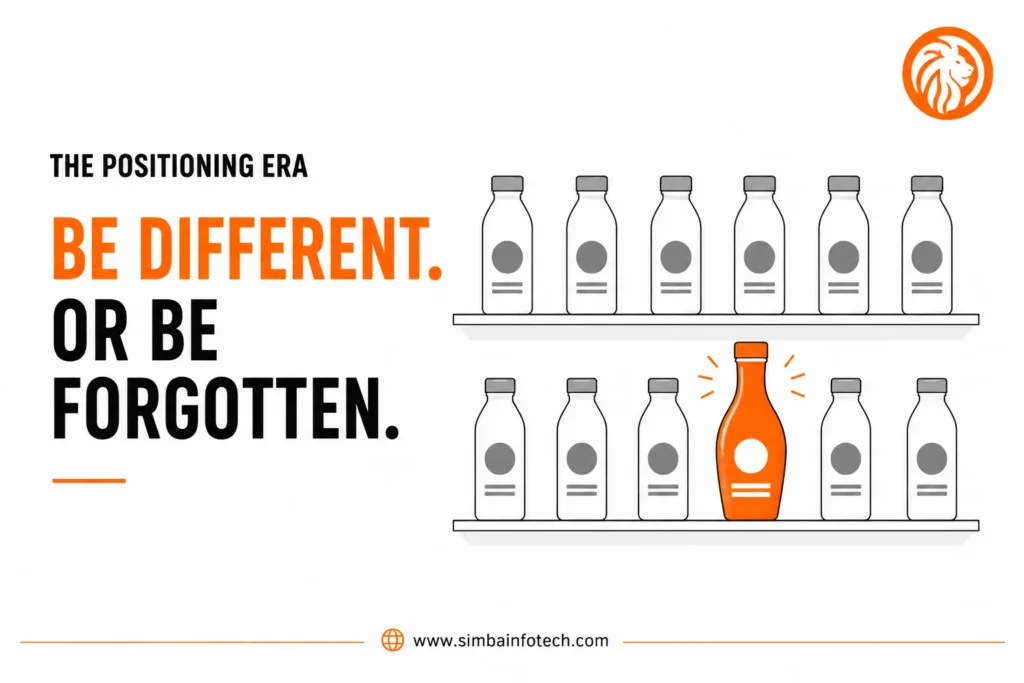
According to them, customers are exposed to too much information. As a result, they simplify. They create mental categories and remember only a few brands in each category. These brands become shortcuts that help people make quick decisions.
This insight changed everything.
Marketing success was no longer about having the best product. It was about being remembered for something clear and specific.
Some brands understood this very well:
- Volvo became known for safety
- BMW became known for driving performance
- FedEx became known for fast delivery
But one of the most powerful examples of positioning came from Volkswagen.
At a time when American cars were large, powerful, and flashy, Volkswagen did the opposite. Its Beetle was small, simple, and very different from everything else in the market. Instead of hiding this difference, Volkswagen embraced it.
In one of the most famous advertising campaigns in history, they used the headline:
“Think Small.”
This was a bold move. While competitors focused on size and power, Volkswagen positioned itself around simplicity, honesty, and practicality. The advertisement did not try to compete directly. It created a completely new perspective.
The result was powerful.
Customers immediately understood what made Volkswagen different.
The lesson was clear.
You do not win by being slightly better.
You win by being clearly different.
This is the core idea of the Positioning Era.
Customers do not compare every feature. They do not analyze every option. Instead, they look for simple reasons to choose. Positioning helps businesses create that simple reason.
This idea is still extremely relevant today. Whether a business works with a digital marketing agency, invests in SEO, runs Google Ads campaigns, or partners with a social media marketing agency, the challenge remains the same.
Customers are overwhelmed with information.
So the real question becomes:
Why should customers remember you?
The brands that succeed are not those that try to do everything. They are the brands that become known for one clear idea.
However, as the evolution of marketing continued, businesses discovered something even deeper. Being remembered was important, but it was not enough. Customers were not just choosing products. They were building trust, forming emotional connections, and developing relationships with brands.
And that realization led to the next major stage in the evolution of marketing: the Brand Era.
How Did the Brand Era Change the Evolution of Marketing?
As the evolution of marketing continued, businesses began to understand an important truth. Being remembered was powerful. But it was not enough.
A customer might remember a brand, but that does not guarantee they will choose it. Over time, companies realized that customers were not just making decisions based on logic or product features. They were influenced by feelings, trust, and past experiences.
This marked the beginning of the Brand Era.

During this stage, marketing shifted from simply creating awareness to building relationships. Businesses started focusing on how customers feel about a brand, not just what they know about it.
This is where branding became one of the most important concepts in marketing.
One of the key thinkers who shaped this era was David Aaker. He introduced the idea of brand equity, which means the value a brand adds beyond the product itself. According to Aaker, a strong brand is built on several key elements that work together.
Aaker’s model of brand equity includes:
- Brand Awareness – Do people recognize and remember the brand?
- Perceived Quality – Do customers believe the product is high quality?
- Brand Associations – What comes to mind when people think of the brand?
- Brand Loyalty – Do customers come back again and again?
Let’s understand this with a simple example.
Think about Apple.
Even before looking at a product, most people already know the brand. That is brand awareness. Customers often believe Apple products are premium and high quality, which is perceived quality. When people think of Apple, they associate it with innovation, design, and simplicity. That is brand association. And many customers continue buying Apple products again and again, which shows brand loyalty.
All of this together creates strong brand equity. Now compare this to a lesser-known brand offering similar features at a lower price. Even if the product is technically good, customers may hesitate.
Why?
Because the brand does not yet have trust.
This is what changed in the evolution of marketing.
Earlier, businesses focused on:
- Making better products
- Selling more aggressively
- Being remembered through positioning
Now, they focused on building long-term trust.
Companies realized that when customers trust a brand, they do not compare every option. They do not spend hours researching alternatives. They simply choose what feels reliable and familiar.
This is why branding became a long-term investment. Unlike advertising campaigns, which may last for weeks or months, brands are built over years. Every interaction matters. Every product experience, every message, and every campaign shapes how customers perceive the brand.
This idea is still extremely relevant today.
Whether a business works with a digital marketing agency, invests in SEO, runs Google Ads campaigns, or partners with a social media marketing agency, the goal is not just to generate traffic or clicks.
The real goal is to build trust.
For example, many e-commerce marketing agencies and performance marketing agencies focus on conversions and short-term results. But the brands that succeed over time are those that combine performance with strong brand building.
Because in the end, people do not just buy products. They buy what those products represent, buy brands they believe in. However, even this was not the final answer.
As marketers continued studying customer behavior, they discovered something surprising. Even strong brands could be influenced by small changes. Even loyal customers did not always act logically.
This led to another important realization. Customers are not always rational. And understanding how people actually think would lead to the next stage in the evolution of marketing: The Behavioral Era.
How Did Behavioral Science Change the Evolution of Marketing?
Up to this point in the evolution of marketing, businesses believed they were getting closer to understanding customers. They had learned how to produce efficiently, how to sell aggressively, how to position themselves clearly, and how to build strong brands. From a business perspective, it felt like the system was complete.
Before we move forward, it is important to clarify something.
The stage we are about to discuss is not always defined as a formal “era” in traditional marketing textbooks. You will not always find it labeled as the Behavioral Era alongside the Product Era or Sales Era.
However, something important happened during this time.
A new way of understanding customers emerged—one that challenged decades of economic thinking and completely changed how businesses approach marketing.
Rather than introducing a new channel or strategy, this shift explained why previous marketing approaches worked in the first place. It revealed how people actually make decisions, and in doing so, it reshaped every part of marketing—from pricing and branding to advertising and digital campaigns.
This is why it deserves special attention in the evolution of marketing.
The confidence was built on one critical assumption. Customers were rational. Economists had long believed that people make logical decisions. According to traditional economic theory, individuals compare all available options, evaluate costs and benefits, and choose what gives them the greatest value. Based on this idea, businesses were often advised to improve products, reduce prices, and communicate features clearly.
In theory, this made perfect sense. But in reality, it was incomplete. This is where Daniel Kahneman changed everything.
Kahneman, along with his research partner Amos Tversky, spent years studying how people actually make decisions. Instead of relying on theory, they conducted experiments. What they discovered challenged decades of economic thinking.
People do not behave rationally. They behave predictably irrationally and often make system 1 erros.
This idea was so powerful that Kahneman, a psychologist, was awarded the Nobel Prize in Economics. That alone showed something important: understanding human behavior was just as important as understanding markets.
What made his work even more influential was the kind of audience it attracted.
His lectures and masterclasses were not just attended by academics. They drew some of the most influential thinkers and business leaders in the world. In high-level sessions like the 2007 Edge Master Class, attendees included figures such as Jeff Bezos from Amazon, Larry Page and Sergey Brin from Google, Jimmy Wales from Wikipedia, along with Nobel laureates, scientists, and leading innovators.
These were people building global companies. And they were sitting in a room learning one thing:
How people actually think.
In his research, Kahneman explained that the human brain operates using two systems.
- System 1: Fast, automatic, emotional thinking
- System 2: Slow, logical, deliberate thinking

This means people do not carefully analyze every choice. Instead, they rely on intuition, habits, and mental shortcuts. These shortcuts are useful, but they also lead to consistent patterns of bias.
This is where traditional economics started to break down.
Economists believed customers would always choose the best option.
Kahneman showed that customers often choose the easiest, most familiar, or most emotionally appealing option. It also showed that reducing prices does not always increase sales, because price is not just a number. It is a signal. Sometimes, a higher price creates a stronger feeling of value.
This had massive implications for businesses. It meant that improving a product alone was not enough. Businesses started to understand that people do not always make rational choices, so it became important for them that they have to frame or show it in an appealing way, which makes people buy their products.
Later, Dan Ariely expanded these ideas and made them easier to understand through real-world experiments. His work showed that even small changes in how choices are presented can completely change decisions.
For example, Ariely demonstrated that when people are given three pricing options, they often choose the middle one, even if it is not the best value. This is known as the decoy effect, and it is widely used in pricing strategies today.
He also showed that people rely heavily on the first number they see when making decisions. This is called anchoring. For instance, if a product is first shown at a high price and then discounted, customers perceive it as a better deal, even if the final price is still high.
Some of the most important behavioral patterns discovered during this era include:
- Anchoring – The first piece of information shapes future decisions
- Loss Aversion – People fear losing more than they value gaining
- Paradox of Choice – Too many options reduce decision-making
- Status quo bias – People do things they are used to doing
- Social Proof – People follow the behavior of others
These patterns are not random.
They are predictable.
And once marketers understood them, the evolution of marketing changed again.
This is where Rory Sutherland brought these ideas into modern marketing practice. He argued that marketing is not just about improving products or optimizing processes. It is about changing perception.
According to Rory, a product does not need to change physically to become more valuable. Sometimes, changing how people perceive it is enough.
This explains many real-world examples:
- A product feels more premium when packaging improves
- The same experience feels better when expectations are higher
- A higher price can sometimes increase perceived value
These ideas challenge traditional business thinking.
Instead of asking, “How do we improve the product?” marketers began asking, “How do customers experience the product?”
This shift is extremely important in today’s world.
Modern digital marketers, whether working in a digital marketing agency, running Google Ads campaigns, improving SEO, or working with e-commerce marketing agencies and performance marketing agencies, operate in an environment where attention is limited and decisions are fast.
Customers do not read everything. They do not compare every option, and often decide quickly, often within seconds. Yes, maybe we believe it or not, but unconsciously we decide whether we want to buy it or not.
This means understanding behavior is no longer optional.
It is essential.
The Behavioral Era revealed something that previous stages of the evolution of marketing had missed. Customers are not machines. They are human Who is influenced by context, emotion, perception, and bias. And once businesses understood this, marketing stopped being just a business function. It became a mix of psychology, economics, and human understanding.
This realization opened the door to the next stage. If human behavior can be understood, can it be predicted? And if it can be predicted, can it be automated? That question leads directly to the next phase in the evolution of marketing: Digital Marketing
How Did the Digital Marketing Era Change the Evolution of Marketing?
After the Behavioral Era, businesses had something extremely powerful: a deeper understanding of how people think and make decisions. Researchers had shown that customers are not always logical and that their choices are influenced by perception, emotion, context, and cognitive biases. However, there was still a major limitation. Understanding behavior through research and experiments was valuable, but observing that behavior in real time and at scale was far more powerful.
This is where the Digital Marketing Era transformed the evolution of marketing completely.
The rise of the internet was not just a technological shift; it was a behavioral shift. For the first time, people were not simply consuming information through traditional media. They were actively searching, clicking, scrolling, sharing, commenting, and interacting with content every day. This created a new kind of customer—one who was connected, informed, and increasingly in control of their buying journey.
The arrival of smartphones accelerated this transformation even further. Marketing was no longer limited to televisions, newspapers, magazines, or billboards. It became portable and moved directly into people’s pockets. Customers could access information, compare products, read reviews, watch videos, and make purchases from virtually anywhere. Whether commuting, working, relaxing at home, or waiting in line, people remained connected to digital platforms throughout the day.
As smartphone adoption increased, content consumption exploded. Social media platforms, video-sharing websites, mobile applications, streaming services, and messaging platforms became deeply integrated into everyday life. Consumers were no longer exposed to a handful of advertisements during specific moments of the day. Instead, they encountered thousands of messages, notifications, recommendations, and pieces of content across multiple devices and platforms.
This shift gave rise to what is now known as the attention economy. In previous eras, businesses primarily competed on product quality, pricing, distribution, or brand recognition. In the digital era, they also had to compete for something far more limited: attention. Time, focus, and engagement became valuable resources, and brands had to find ways to capture and retain them in an increasingly crowded environment.
This new reality made digital marketing essential for business growth.

Search engines such as Google fundamentally changed how people discover products and services. Instead of passively receiving advertisements, customers could actively search for solutions to their problems. This created enormous opportunities for businesses that could appear at the right moment. As a result, SEO (Search Engine Optimization) became one of the most important disciplines in modern marketing. Companies invested heavily in improving their visibility so they could attract customers who were already demonstrating interest through search behavior.
At the same time, Google Ads introduced a powerful concept known as intent-based marketing. Rather than displaying advertisements to broad audiences with uncertain interest, businesses could target users based on specific search queries. This made advertising more relevant, more efficient, and significantly easier to measure than many traditional marketing channels.
Social media platforms introduced another major shift. Customers were no longer only searching for products when they needed them; they were consuming content continuously throughout the day. Scrolling became a habit, and platforms such as Facebook, Instagram, LinkedIn, YouTube, TikTok, and X transformed how people discover brands, engage with businesses, and make purchasing decisions.
This environment fueled the growth of:
- Social media marketing agencies
- Content marketing strategies
- Influencer-driven campaigns
- Always-on brand communication
For the first time in the evolution of marketing, brands needed to remain visible and relevant every day rather than relying solely on periodic advertising campaigns.
Behind the scenes, another transformation was taking place: the rise of data-driven marketing. Every click, scroll, page view, video watch, and interaction could now be tracked and analyzed. Businesses gained unprecedented visibility into customer behavior, allowing them to understand how users moved through websites, responded to advertisements, and interacted with content.
This capability led to the growth of:
- Performance marketing agencies
- Ecommerce marketing agencies
- Data-driven decision making
- Conversion optimization strategies
For the first time in marketing history, campaigns could be measured with remarkable precision. Marketers could identify which channels generated traffic, which advertisements produced conversions, and which customer journeys resulted in sales.
However, this abundance of data introduced a new challenge. Many businesses became overly focused on metrics such as clicks, impressions, conversions, and engagement rates. While these numbers provided valuable insights, they did not always explain why customers behaved the way they did.
This is where the lessons from the Behavioral Era became even more important. Data can reveal what people do, but understanding psychology helps explain why they do it. Just because something can be measured does not necessarily mean it is meaningful, and some of the most important drivers of human behavior remain difficult to quantify.
At the same time, customers became more sophisticated. They learned to ignore banner advertisements, skip promotional content, scroll past sales messages, and rely more heavily on recommendations, reviews, and social proof. As consumers gained greater control over what they consumed, earning attention became increasingly difficult.
Today, whether a business works with a digital marketing agency, invests in SEO, runs Google Ads campaigns, or partners with social media marketing agencies and online advertising agencies, the fundamental challenge remains the same: how to earn attention in a world filled with distractions. Brands must find ways to remain relevant when customers are constantly scrolling, comparing options, and consuming endless streams of content.
The Digital Marketing Era gave businesses powerful tools for reaching audiences, measuring performance, and optimizing campaigns. At the same time, it intensified competition because every brand gained access to similar platforms and technologies. Customers suddenly had more choices than ever before, and every piece of content had to compete against countless alternatives for a few seconds of attention.
This is why digital marketing is about far more than technology or advertising platforms. Success depends on understanding human behavior, capturing attention at the right moment, and delivering value in ways that resonate with increasingly informed consumers.
As transformative as this era has been, it naturally leads to the next question. If businesses can track behavior, analyze data, and measure attention at scale, can they also predict what customers will do next?
That question leads directly to the next stage in the evolution of marketing: Current era of marketing
How Is the Current Era Shaping the Evolution of Marketing?
If we compare today’s marketing with the past, one thing is clear. Marketing no longer changes slowly over many years. It changes all the time.
Businesses today work in a fast-moving world. New tools come out quickly. Customer needs keep changing. Competition is growing every day. What works today may stop working tomorrow.
This constant change is what defines the current era of marketing.
One big reason for this change is artificial intelligence (AI).
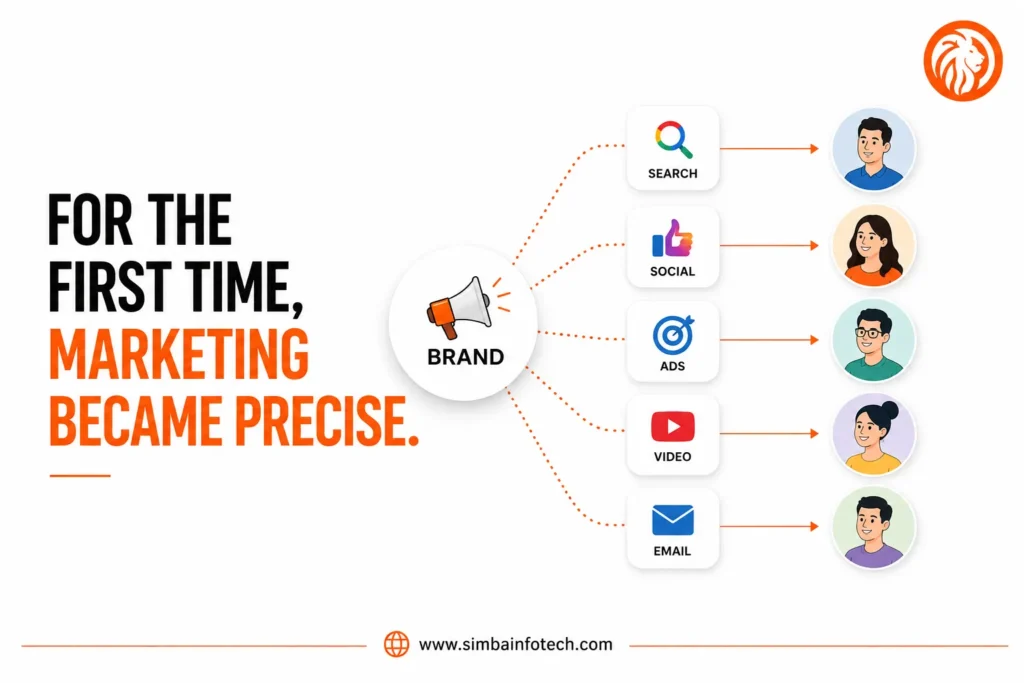
AI is now used in daily marketing work. Businesses use it to study customer data, improve ads, suggest products, and automate tasks. Platforms like Google Ads use AI to decide where ads should appear and who should see them. Social media platforms also use AI to show people content they are most likely to engage with.
Because of this, marketers are not doing everything manually anymore. They are working with systems that help make decisions.
Another important change is personalization.
Customers now expect brands to understand them. They want to see content, products, and offers that match their interests. For example, online stores suggest products based on what you have seen before. Social media shows content based on your activity. Emails are sent based on what you do online.
Because of this, general or random marketing messages do not work well anymore. Businesses must make their communication more relevant.
The way people use the internet has also changed.
Smartphones made a big difference. People are always connected. They scroll through social media, watch videos, check messages, and search for information throughout the day.
Because of this, attention has become very limited. Businesses are not only competing with other businesses. They are competing with everything people see on their screens. Even if a company creates something useful, there is no guarantee people will notice it. This makes marketing harder. Another big change is how marketing works over time.
Earlier, companies ran campaigns for a short time and then stopped. Today, marketing never stops. Businesses are always running ads, posting content, testing ideas, and improving results. Whether a company works with a digital marketing agency, uses SEO, runs Google Ads, or uses social media marketing, it has to keep adjusting all the time. Technology has also become easier to access.
Today, almost every business can use tools like SEO platforms, analytics tools, ad platforms, and automation systems. This means having tools is no longer special. What matters now is how well a business uses them. Companies that think clearly, understand customers better, and communicate well usually perform better.
This is what makes the current era different. In the past, marketing had clearer rules, while today, it is more complex. Things keep changing And businesses must keep learning and adapting. The evolution of marketing no longer feels like separate stages. It feels like something that is happening all the time.
Conclusion
The evolution of marketing shows that marketing has never stood still. It has changed with technology, competition, media, and most importantly, with people. What began as a product-focused activity slowly became customer-focused, then brand-focused, then behavior-driven, and today it is shaped by digital platforms, artificial intelligence, personalization, and constant change.
This journey also explains why modern businesses cannot rely on one simple formula. A digital marketing agency today must do far more than just run advertisements. It must understand customer behavior, build trust, improve visibility, and help brands stay relevant in a crowded market. Whether a business is investing in SEO, Google Ads, social media marketing, online advertising, or working with performance marketing agencies and ecommerce marketing agencies, the real challenge is the same: how to earn attention and remain memorable.
The current era of marketing is powerful, but it is also demanding. Customers are always connected, always comparing,nothing is far more than a click and always consuming content. This means businesses must combine strong strategy with the right tools. Social media marketing agencies, digital marketers, online advertising agencies, and even freelance digital marketing professionals now work in a world where speed, relevance, and clarity matter more than ever.
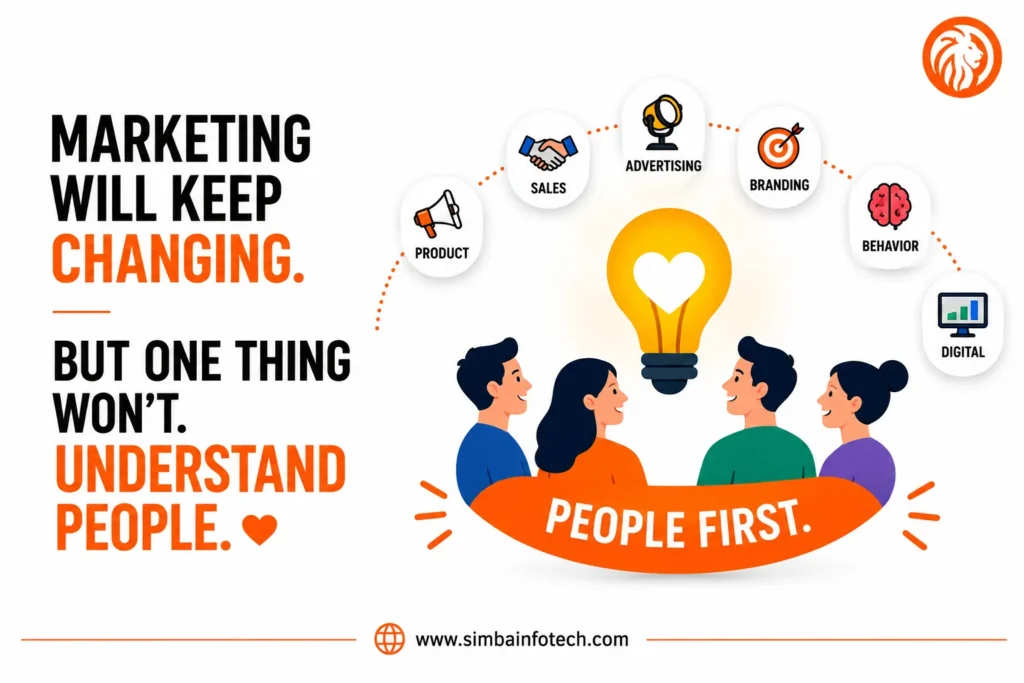
In the end, the evolution of marketing is not just the story of changing tools. It is the story of how businesses learned to understand people more deeply. From traditional advertising to digital campaigns, from branding to behavioral science, and from search engines to AI, every stage has pushed marketing closer to one truth: successful marketing is not only about reaching customers. It is about understanding them, serving them, and giving them a reason to choose you again and again.
Key Takeways
- The evolution of marketing shows that marketing has always changed with competition, technology, media, and customer behavior.
- In the early stages, businesses focused mainly on making and selling products. Over time, marketing became more customer-focused, brand-focused, and behavior-driven.
- Thinkers such as Philip Kotler, Al Ries, Jack Trout, David Aaker, Daniel Kahneman, and others changed how businesses understand customers and marketing strategy.
- The digital marketing era changed everything by making customer behavior easier to track through SEO, Google Ads, social media marketing, and online advertising.
- In the current era, businesses must do more than just get attention. They must stay relevant, build trust, and communicate clearly in a fast-moving digital world.
- A successful digital marketing agency today needs to combine technology, customer understanding, branding, data, and strategy to help businesses grow in a crowded market.
FAQs
What is the evolution of marketing?
The evolution of marketing refers to how marketing ideas, strategies, and tools have changed over time. Marketing began with a strong focus on products and sales, then moved toward customer needs, positioning, branding, digital marketing, behavioral science, and today’s AI-driven and personalized marketing environment.
Why is the evolution of marketing important for businesses today?
The evolution of marketing is important because it helps businesses understand why marketing works differently today than it did in the past. Customers now have more choices, more information, and higher expectations. This means businesses must go beyond simple advertising and focus on trust, clarity, relevance, and customer experience.
How did digital marketing change the evolution of marketing?
Digital marketing changed the evolution of marketing by making customer behavior easier to track and measure. Through SEO, Google Ads, social media marketing, and online advertising, businesses can now reach customers more precisely, test campaigns in real time, and improve performance based on actual data.
What is the role of a digital marketing agency in the current era of marketing?
A digital marketing agency helps businesses manage and improve their online presence in a fast-changing digital world. This can include SEO, Google Ads, content strategy, social media marketing, performance marketing, and customer analysis. In the current era, a strong digital marketing agency must combine technology, creativity, and customer understanding.
What is the biggest lesson from the evolution of marketing?
The biggest lesson from the evolution of marketing is that successful marketing is not just about selling products. It is about understanding people. Over time, marketing has shown that customer behavior, trust, perception, and relevance matter just as much as the product itself.