- 06/07/2026
- Simba Infotech
- 0
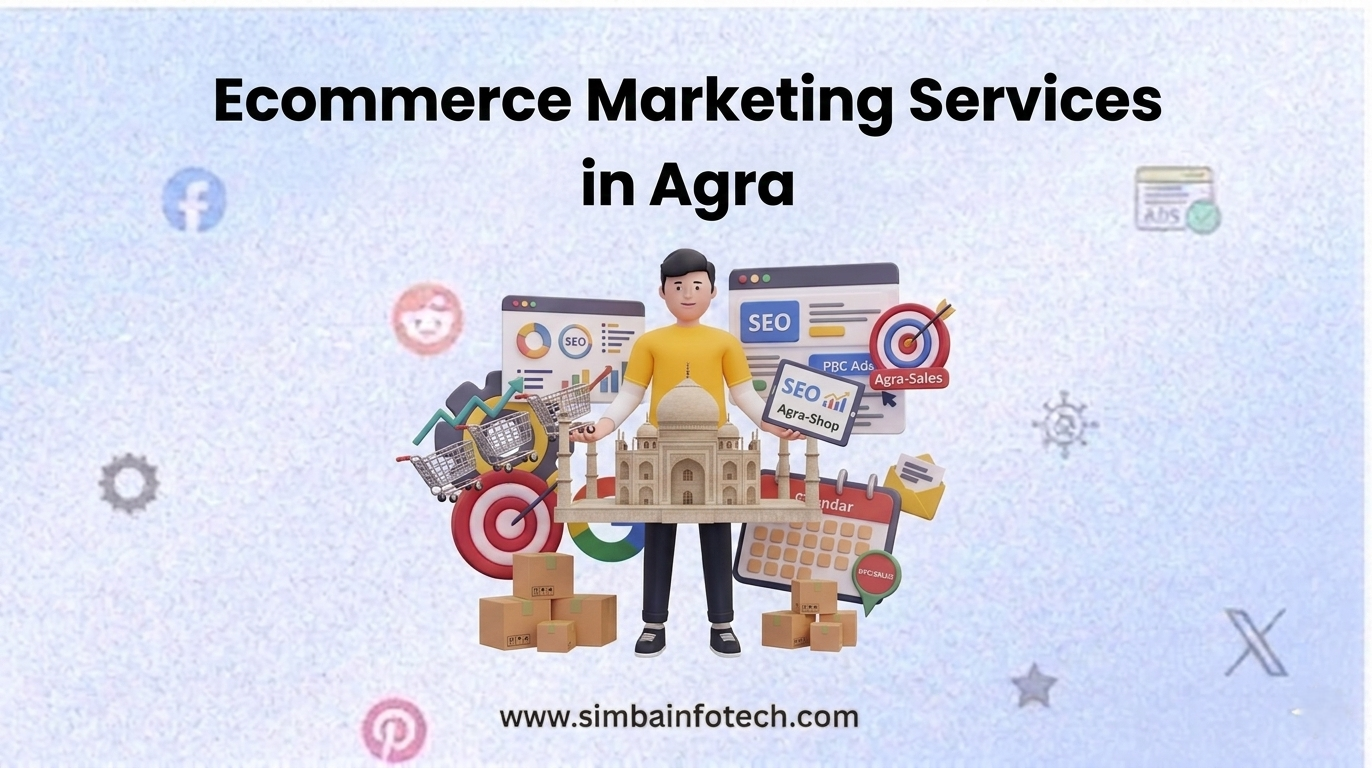
Ecommerce Marketing Services in Agra: Complete Guide for Online Business Growth
Are you looking for the best ecommerce marketing services in Agra? Whether you sell handicrafts, leather goods, or any product online — the right digital marketing strategy can transform your business. Agra is a city full of talented artisans and ambitious entrepreneurs. But without proper ecommerce marketing, even the best products stay hidden. This guide will help you understand what ecommerce marketing services include, why they matter, and how to choose the right agency in Agra.
What Are Ecommerce Marketing Services?
Ecommerce marketing services are strategies and tools used to promote an online store. They help businesses attract more visitors, convert them into buyers, and turn buyers into loyal customers.
These services cover everything from search engine optimization (SEO) to social media ads. They are designed specifically for online selling platforms like Shopify, WooCommerce, Amazon, Flipkart, and Meesho.
Key goals of ecommerce marketing:
- Increase website traffic and product visibility
- Improve conversion rates and sales
- Build brand awareness in a competitive market
- Retain existing customers and grow repeat purchases
- Reduce cost per acquisition (CPA) over time
Why Agra Businesses Need Ecommerce Marketing
Agra is famous worldwide for the Taj Mahal — but its business community is equally powerful. The city has a booming market for leather products, marble crafts, petha sweets, and clothing.
More buyers are now shopping online. If your business is not visible on Google or social media, you are losing sales to competitors every single day.
Here is why ecommerce marketing is essential for Agra businesses:
- Millions of customers search for Agra products online every month
- Local artisans and sellers face competition from national brands
- Digital marketing levels the playing field for small businesses
- Online stores can sell to customers across India and globally
- You get measurable results — unlike traditional advertising
Core Ecommerce Marketing Services
1. Search Engine Optimization (SEO) for Ecommerce
SEO helps your product pages rank higher on Google. When someone searches “buy marble art online” or “leather bag Agra,” your store should appear on the first page.
Ecommerce SEO includes:
- Keyword research — Finding what your customers are searching
- On-page optimization — Optimizing product titles, descriptions, and images
- Technical SEO — Improving site speed, mobile-friendliness, and structure
- Link building — Getting other websites to link to your store
- Local SEO — Ranking for searches like “ecommerce stores in Agra”
A good SEO strategy takes 3 to 6 months to show results. But it brings long-term, free organic traffic that keeps growing over time.
2. Pay-Per-Click (PPC) Advertising
PPC ads give you instant visibility on Google, Amazon, and Flipkart. You only pay when someone clicks your ad. This is one of the fastest ways to drive traffic to your online store.
Types of PPC ads used in ecommerce:
- Google Shopping Ads — Show your product images in search results
- Google Search Ads — Text ads targeting high-intent buyers
- Amazon Sponsored Products — Boost visibility on Amazon marketplace
- Flipkart Ads — Promote your listings on Flipkart
- Display Ads — Banner ads on websites and apps
PPC is perfect for new stores that need quick results. Experienced agencies in Agra can manage your budget and maximize your return on ad spend (ROAS).
3. Social Media Marketing for Online Stores
Social media is where your customers spend their time. Platforms like Instagram, Facebook, and Pinterest are powerful tools for ecommerce businesses.
Social media marketing for ecommerce includes:
- Content creation — Product photos, videos, and reels that attract attention
- Paid social ads — Targeting specific audiences by age, interest, and location
- Influencer marketing — Partnering with local influencers to promote your products
- Community building — Building a loyal following that trusts your brand
- Shopping features — Instagram Shop and Facebook Shop make buying easy
Agra has a unique visual story to tell — marble art, leather craftsmanship, and cultural heritage. Social media is the perfect platform to showcase this.
4. Email Marketing and Automation
Email marketing is one of the highest ROI channels in ecommerce. It costs very little but generates strong results when done correctly.
Effective email marketing strategies include:
- Welcome emails for new subscribers
- Abandoned cart recovery emails
- Product recommendation emails based on past purchases
- Seasonal sale announcements and discount offers
- Loyalty rewards and re-engagement campaigns
With marketing automation tools like Klaviyo or Mailchimp, you can send the right message to the right customer at the right time — without doing it manually every day.
5. Marketplace Management (Amazon, Flipkart, Meesho)
Many Agra sellers use marketplaces like Amazon and Flipkart to reach millions of buyers. But listing your products is not enough — you need active marketplace management.
Marketplace management services include:
- Product listing creation and optimization
- Keyword-rich titles and bullet points for better search ranking
- High-quality product image editing and A+ content creation
- Review management and seller rating improvement
- Inventory management and pricing strategy
- Running Sponsored Product Ads within the marketplace
A well-managed marketplace store can generate consistent daily sales without building your own website.
6. Conversion Rate Optimization (CRO)
Getting traffic to your store is only half the battle. CRO focuses on converting visitors into paying customers.
CRO techniques include:
- A/B testing — Testing two versions of a page to see which performs better
- User experience (UX) improvements — Making the site easy to navigate
- Clear call-to-action buttons — Directing buyers toward the checkout
- Trust signals — Reviews, ratings, security badges, and return policies
- Page speed optimization — Faster pages reduce bounce rates significantly
Even a 1% increase in conversion rate can result in a major boost in monthly revenue for your store.
7. Content Marketing and Product Blogging
Content marketing builds trust and drives organic traffic over time. A well-written blog can attract thousands of potential customers without spending on ads.
Content marketing strategies for ecommerce:
- Writing SEO blogs about topics related to your products
- Creating buying guides and product comparison articles
- Video content showing product usage and manufacturing
- Infographics about your product category
- Guest posting on popular shopping and lifestyle websites
For Agra businesses, storytelling about craftsmanship and heritage can create a strong brand that attracts both Indian and international buyers.
8. WhatsApp Marketing for Local Businesses
WhatsApp is extremely popular in India and has become a powerful marketing tool. Many Agra businesses use WhatsApp to communicate with customers directly.
WhatsApp marketing strategies include:
- Sending product catalogs and offers via WhatsApp Business
- Broadcast messages for new arrivals and sales
- Customer support and order updates on WhatsApp
- WhatsApp Ads running through Facebook Ads Manager
- Group marketing for loyal and repeat customers
WhatsApp marketing has very high open rates compared to email — making it one of the most effective tools for Indian ecommerce businesses.
Ecommerce SEO Best Practices
Search engine optimization is one of the most powerful tools for any online store. When done right, SEO brings free, consistent traffic to your website every single day. These best practices will help your ecommerce store rank higher on Google and turn more visitors into buyers.
Optimize Your Product Pages
Your product page is where the sale happens. If it is not optimized, you lose both rankings and customers at the same time.
Every product page should have a unique, keyword-rich title that clearly tells Google and the buyer what the product is. Write a clear product description that explains benefits, not just features. Include specifications, materials, size, and usage so the buyer feels confident before purchasing.
Add customer reviews to every product page. Reviews build trust and also add fresh, keyword-rich content automatically. Use high-quality images from multiple angles — good visuals reduce return rates and improve conversions.
Good product pages rank better on Google and convert more visitors into paying customers.
Improve Your Category Pages
Category pages are often overlooked, but they target some of the highest-volume keywords in your niche. Instead of leaving them empty, add a short, well-written description at the top of each category.
Use clear H1 and H2 headings that include your target keyword naturally. Add internal links to top-selling products within that category. This helps Google understand your site structure and helps users find what they need faster.
A well-optimized category page can rank for broad terms like “leather bags online” or “marble gifts India” — driving hundreds of visitors every month without spending on ads.
Focus on Technical SEO
Technical SEO is the foundation that holds everything else together. If your website has technical problems, even great content will struggle to rank.
The most important technical factors to keep in check are:
- Fast page loading speed — Slow pages lose visitors and rankings
- Mobile-friendly design — Most buyers shop from their phones
Beyond these two, make sure your site has a secure HTTPS connection, a properly submitted XML sitemap, and structured data markup (schema) so Google can display rich results like star ratings and prices directly in search.
Run a technical audit every few months using tools like Google Search Console or Screaming Frog. Fix broken links, duplicate content, and crawl errors as soon as they appear.
Build Quality Backlinks
Backlinks are votes of confidence from other websites. When trusted sites link to yours, Google sees your store as more authoritative and pushes it higher in search results.
The most effective way to earn backlinks is through guest posting on relevant blogs in your industry. Write helpful, informative articles and include a natural link back to your store. You can also get listed in local business directories and industry-specific listing sites — these are easy wins that also improve your local SEO.
Running a PR campaign or press release around a product launch or milestone can earn coverage from news sites and blogs. Even a handful of high-quality backlinks from trusted sources can significantly improve your domain authority over time.
Focus on quality over quantity. One backlink from a well-known website is worth more than fifty from low-quality sources.
Mobile Commerce Is Essential
Most online shoppers now use smartphones. Your store must be optimized for mobile devices.
Mobile optimization includes:
- Fast loading pages on mobile
- Responsive website design
- Easy-to-use navigation
- Simple and quick checkout
A poor mobile experience drives customers away.
Common Ecommerce Challenges and Solutions
Running an online store is exciting — but it comes with real challenges. Every ecommerce business, big or small, faces obstacles along the way. The good news is that every challenge has a practical solution. Here are the most common ecommerce problems and exactly how to fix them.
Challenge 1: High Competition
The online marketplace is crowded. Thousands of stores sell similar products, and standing out can feel impossible. Competing only on price is a race to the bottom — and it is not sustainable.
The real solution is to build a strong brand that people trust and remember. Focus on delivering an outstanding customer experience at every touchpoint — from your website design to packaging to after-sales support. Stay consistent with your marketing so your audience sees you regularly. When customers feel connected to your brand, they choose you over cheaper competitors every time.
Challenge 2: Low Conversion Rates
Getting traffic to your store is only half the battle. If visitors are leaving without buying, something on your site is stopping them. This is one of the most frustrating problems in ecommerce.
Start by improving your product pages — better images, clearer descriptions, and honest customer reviews make a huge difference. Simplify your checkout process as much as possible. Every extra step you remove increases the chance of a completed purchase. Also add trust signals like star ratings, secure payment badges, and a clear return policy. When buyers feel safe, they buy.
Challenge 3: Cart Abandonment
A shopper adds products to their cart and then disappears. This happens more often than most store owners realize — the average cart abandonment rate is over 70%. That is a lot of lost revenue sitting right at the finish line.
The most effective fix is sending abandoned cart emails within a few hours of the drop-off. A simple reminder with the product image and a direct link back to checkout recovers many sales. Running remarketing ads on Google and Facebook also brings these shoppers back. If needed, offer a small discount or free shipping to give them the final push to complete the purchase.
Challenge 4: Rising Ad Costs
Paid advertising on Google and Facebook has become increasingly expensive. Many businesses are spending more but seeing lower returns than before. Relying only on paid ads is a risky long-term strategy.
The smartest move is to invest in SEO alongside your ads. SEO builds organic traffic that grows over time and costs nothing per click. On the paid side, improve your audience targeting so your ads reach people who are most likely to buy. Review and optimize your campaigns regularly — pause what is not working and put more budget behind what is. Better targeting always brings the cost per conversion down.
Why Choose Professional Ecommerce Marketing Services?
Working with an experienced agency saves you time and money.
Benefits of professional services:
- Deep industry expertise
- Access to advanced marketing tools
- Data-driven campaign decisions
- Consistent reporting and transparency
- Faster and better results
You focus on running your business. Experts handle your marketing.
How to Choose the Right Ecommerce Marketing Agency
Use these criteria when selecting a marketing partner:
- Experience — Look for proven ecommerce results and case studies
- Transparency — They should provide regular performance reports
- Custom Strategy — Avoid agencies offering one-size-fits-all packages
- Communication — Regular updates and clear communication matter
- Results — Ask for testimonials from real clients
Future Trends in Ecommerce Marketing
The ecommerce landscape is changing fast. These trends are shaping the future:
- Artificial Intelligence — Smarter product recommendations and personalization
- Voice Search — More customers searching using voice assistants
- Video Commerce — Selling products through live videos and short reels
- Marketing Automation — Automated campaigns based on customer behavior
- Predictive Analytics — Using data to predict buying trends
Businesses that adopt these trends early gain a strong competitive edge.
Conclusion
Ecommerce marketing is essential for any online business that wants to grow. SEO, PPC, social media, email marketing, content creation, and conversion optimization all play an important role.
Businesses in Agra that invest in professional ecommerce marketing gain more visibility, better traffic, and consistent sales growth.
Start with a clear strategy. Track your results. Keep improving. That is how successful ecommerce businesses are built.
Frequently Asked Questions
What are ecommerce marketing services?
Ecommerce marketing services help online stores increase visibility, attract customers, and generate more sales. They include SEO, PPC advertising, social media marketing, email marketing, marketplace marketing, and conversion rate optimization — all working together for maximum results.
How long does ecommerce SEO take to show results?
Most SEO campaigns start showing measurable improvements within 3 to 6 months, depending on competition and website condition. PPC ads can deliver results within the first week. We recommend combining both for short-term and long-term growth together.
Is PPC better than SEO for ecommerce?
Both are important and work best together. PPC gives you immediate traffic and sales, while SEO builds long-term sustainable growth with free organic traffic. A balanced strategy using both channels gives the best results for your ecommerce business in Agra.
Why is social media important for ecommerce?
Social media helps increase brand awareness, engage customers, and drive product sales through targeted campaigns. Platforms like Instagram and Facebook are where millions of Indian customers discover new products every day — especially for visual products like fashion, handicrafts, and home decor.
Can local businesses in Agra benefit from ecommerce marketing?
Yes. Ecommerce marketing helps local businesses in Agra reach more customers, increase online sales, and build strong brand visibility — across India and internationally. Even with a small budget, a well-managed campaign delivers strong returns for Agra businesses.
What makes Simba Infotech different from other agencies in Agra?
We combine local Agra market knowledge with proven ecommerce marketing expertise. Every plan is customized for your products, target customers, and budget — not a copy-paste package. We provide full transparency with monthly reports, a dedicated account manager, and no hidden fees or lock-in contracts.
Ready to Grow Your Ecommerce Business?
Simba Infotech provides complete ecommerce marketing solutions in Agra:
- Ecommerce SEO
- Google Ads Management
- Social Media Marketing
- Conversion Rate Optimization
- Content Marketing
- Marketplace Marketing
- Performance Tracking and Reporting
Contact Simba Infotech today and build an ecommerce presence that drives consistent traffic, leads, and sales.