- 07/02/2026
- Simba Infotech
- 0
Introduction
Running a Shopify store is exciting because you can sell products to customers all over the world. But just getting visitors to your store is not enough. The real success comes when you convert those visitors into paying customers and then turn them into repeat buyers.
This is where email marketing becomes one of the most powerful tools in your Digital marketing strategy.
Unlike social media platforms, where algorithms control your reach, email gives you direct access to your customers. You are speaking directly to people who already showed interest in your brand.
In this detailed guide, you will learn the best email marketing strategies for Shopify stores, how to apply them in real life, and how to increase your sales using smart automation. We will also explore practical examples so you can easily implement everything step-by-step in your business.
Why Email Marketing is Important for Shopify Stores
Email marketing is not just about sending promotional messages or sharing offers. It is a complete and powerful Digital marketing system that helps you grow your Shopify store in a smart and sustainable way.
When you use email marketing correctly, you are not just selling products—you are building a long-term connection with your customers, increasing trust, and creating repeat sales automatically.
Let’s understand in detail why email marketing is so important for your Shopify business.
Here’s why it is powerful:
1. High Return on Investment (ROI)
One of the biggest advantages of email marketing is its high return on investment. ROI means how much profit you earn compared to how much you spend. In the world of Digital marketing, email marketing consistently delivers one of the highest ROI rates.
Why email marketing has high ROI:
- No cost per click like paid ads
- Ability to reach thousands of customers at once
- Automation reduces manual effort
- Audience is already interested in your products
Real Example:
If you spend a small amount on email tools or setup, you can generate multiple times higher revenue through targeted campaigns.
For example, a ₹1,000 investment can potentially bring ₹5,000 to ₹10,000 in sales depending on your product and strategy.
Simple Understanding:
Low cost plus high conversion potential makes email marketing one of the most profitable Digital marketing channels.
2. You Own Your Audience
One of the most important benefits of email marketing is ownership of your audience. When you build an email list, you are not dependent on any platform or algorithm.
Problem with social media:
- Reach depends on algorithms
- Visibility can drop anytime
- Accounts can be restricted or suspended
- You do not fully control your audience
Advantage of email marketing:
- Direct communication with customers
- No algorithm limitations
- Full control over your audience
- Long-term business asset
Real Example:
If Instagram reduces your reach, your sales may drop suddenly.
But if you have an email list of 10,000 customers, you can still directly send offers and generate sales anytime. This is why owning your audience is a core principle of successful Digital marketing.
3. Builds Strong Customer Relationships
Email marketing helps you build trust and long-term relationships with your customers. Instead of only focusing on selling, you can consistently communicate with your audience and provide value.
How email marketing builds relationships:
- Sharing useful and educational content
- Sending personalized product recommendations
- Providing updates and announcements
- Helping customers solve problems
Real Example:
If you run a skincare store, you can send emails such as:
- How to take care of skin in different seasons
- Skincare routines for different skin types
- Ingredient benefits and usage tips
- Customer success stories
These types of emails improve trust and brand authority. In Digital marketing, trust plays a major role in increasing conversions and customer loyalty.
4. Increases Repeat Sales
One of the biggest advantages of email marketing is increasing repeat purchases. Acquiring new customers is expensive, but selling again to existing customers is easier and more profitable.
Why repeat sales are important:
- Existing customers already trust your brand
- Higher chances of conversion
- Lower marketing cost
- Better profit margins
Real Example:
If a customer buys a t-shirt from your Shopify store, email marketing allows you to:
- Suggest matching products
- Offer discounts on future purchases
- Recommend new arrivals
- Share personalized collections
This encourages customers to return and buy again. In Digital marketing, retention is just as important as acquisition, and email marketing is one of the best tools for retention.
Strategy 1: Build a High-Quality Email List
A strong email marketing system always starts with a high-quality email list. Your success in email marketing depends more on the quality of subscribers than the quantity. A large list with uninterested users will not generate sales, while a small but targeted list can bring high conversions.
To build a strong list, you need to attract people who are genuinely interested in your products. This can be done by offering value in exchange for their email address. Instead of randomly collecting emails, focus on strategic lead generation methods that align with your store audience.
How to build your email list effectively:
- Add pop-ups on your Shopify store with attractive offers
- Offer discounts like “10% OFF on first order”
- Use exit-intent popups to capture leaving visitors
- Add signup forms on homepage, product pages, and checkout pages
- Offer free shipping or special deals for subscribers
When you use these methods, you naturally attract customers who are already interested in your store.
For example, if you run a clothing store, you can offer something like “Get ₹200 OFF on your first order when you subscribe.” This small incentive encourages visitors to share their email and become part of your marketing system.
A well-built email list is the foundation of successful Digital marketing, because it allows you to communicate directly with potential buyers without depending on ads or algorithms.
Strategy 2: Create a Powerful Welcome Email Series
First impressions are extremely important in email marketing. When someone subscribes to your email list, they are most interested in your brand at that moment. This is the best time to engage them through a structured welcome email series.
A welcome series is an automated set of emails designed to introduce your brand, build trust, and guide the customer toward their first purchase.
Structure of a strong welcome email series:
- Email 1: Welcome message with discount offer
- Email 2: Your brand story and mission
- Email 3: Showcase best-selling products
- Email 4: Customer reviews and trust-building content
This sequence slowly builds interest and confidence in your brand.
For example, if you own a Shopify skincare store:
- Email 1: “Welcome! Here is 10% OFF your first order”
- Email 2: “Why our skincare products are different”
- Email 3: “Our best sellers for glowing skin”
- Email 4: “See what our happy customers are saying”
This approach works because it educates the customer instead of directly pushing for a sale. It is a key part of modern Digital marketing automation, helping you convert subscribers into buyers automatically.
Strategy 3: Abandoned Cart Emails (Most Powerful Strategy)
Abandoned cart emails are one of the most effective strategies for recovering lost sales. Studies show that nearly 70% of customers add products to their cart but do not complete the purchase. Instead of losing these customers, you can bring them back using automated email reminders.
How abandoned cart emails work:
- The system detects when a customer leaves without purchasing
- Automated emails are sent at specific time intervals
- Emails encourage the customer to return and complete the purchase
Email sequence structure:
- Email 1: Reminder after 1 hour
- Email 2: Product benefits after 24 hours
- Email 3: Discount or urgency message after 48 hours
This sequence gently reminds the customer while increasing motivation to buy.
For example, if someone adds shoes worth ₹2,000 but does not complete the purchase, your emails can be:
- “You left something behind”
- “Still thinking? Here’s why customers love these shoes”
- “Get 10% OFF if you complete your order today”
This strategy is one of the strongest revenue-generating techniques in Digital marketing for Shopify stores, because it targets customers who are already close to buying.
Strategy 4: Personalization in Emails
Generic emails often fail because customers do not feel connected to them. Personalization helps you make each customer feel valued and understood, which significantly improves engagement and conversions. Personalization means tailoring your emails based on customer behavior, preferences, and data.
How to personalize your emails:
- Use customer names in subject lines and messages
- Recommend products based on browsing or purchase history
- Send birthday or anniversary offers
- Suggest related or complementary products
When emails feel personal, customers are more likely to open and act on them.
For example, instead of sending a general message like “Buy our products today,” you can say “Hi Rahul, these new arrivals match your style.”
This small change creates a stronger emotional connection and improves results. Personalization is a core element of modern Digital marketing strategies, especially for eCommerce success.
Strategy 5: Segment Your Audience
Segmentation means dividing your email subscribers into different groups based on behavior, interests, or purchase history. This allows you to send more relevant emails instead of one message to everyone. When your emails are targeted, they become more effective and result in higher conversions.
Common ways to segment your audience:
- New customers
- Returning customers
- High-value customers
- Abandoned cart users
- Product-specific interest groups
Each group should receive customized messaging.
For example, if you run a fitness store:
- Beginners receive workout guides and starter kits
- Advanced users receive premium supplement offers
- Active buyers receive exclusive deals
This approach improves engagement because each customer receives content that matches their needs. Segmentation makes your Digital marketing strategy more focused, efficient, and profitable.
Strategy 6: Post-Purchase Emails
Many Shopify store owners stop communication after a customer makes a purchase, which is a missed opportunity. Post-purchase emails help you maintain engagement and increase future sales. These emails are designed to support the customer after buying your product.
Types of post-purchase emails:
- Thank you emails
- Order tracking updates
- Product usage guides
- Upsell or cross-sell recommendations
These emails enhance customer experience and build long-term trust.
For example, if someone buys a phone case, you can send:
- “Thank you for your purchase!”
- “Here’s how to protect your phone better”
- “You may also like these accessories”
This helps you stay connected with customers and strengthens your Digital marketing relationship with them.
Strategy 7: Win-Back Inactive Customers
Not all customers stay active forever. Some stop buying after a while, but that does not mean they are lost. Win-back campaigns help you bring them back. These emails are designed to re-engage inactive users and encourage them to shop again.
Win-back email ideas:
- Special discount offers
- “We miss you” messages
- New product announcements
- Exclusive return offers
For example, you can send: “We noticed you haven’t shopped in a while. Here’s 15% OFF to welcome you back.”
This simple approach often brings inactive customers back into your sales funnel. Win-back campaigns are a powerful part of Digital marketing strategy, especially for increasing customer lifetime value.
Strategy 8: Seasonal Campaign Emails
Seasonal campaigns use festivals, holidays, and special occasions to boost sales. Customers are more likely to buy during festive seasons, making it the perfect time for targeted email campaigns.
Examples of seasonal campaigns:
- Diwali Sale
- Christmas Offers
- New Year Discounts
- Summer or Winter sales
These campaigns create urgency and excitement among customers.
For example: “Big Diwali Sale – Flat 20% OFF on all products for 3 days only.” Seasonal marketing is one of the most effective tactics in Digital marketing planning, as it aligns with customer buying behavior.
Strategy 9: A/B Testing for Better Results
A/B testing helps you improve your email performance by comparing two versions of the same email. Instead of guessing what works, you test different elements and analyze results.
What you can test:
- Subject lines
- Email designs
- Call-to-action buttons
- Images and layout
For example:
- Email A: “50% OFF Today Only”
- Email B: “Last Chance to Save 50%”
By analyzing which email performs better, you can continuously improve your strategy. A/B testing is an important part of data-driven Digital marketing optimization.
Strategy 10: Use Automation Tools
Email automation tools help you manage and scale your campaigns without manual effort. These tools send emails automatically based on customer behavior and predefined triggers.
Popular tools:
- Klaviyo
- Mailchimp
- Shopify Email
Automation improves efficiency and saves time while increasing accuracy.
Key benefits of automation:
- Emails are sent automatically based on actions
- Customer behavior is tracked in real time
- Conversion rates improve due to timely messaging
- Marketing becomes scalable and consistent
Automation is the backbone of modern Digital marketing systems, especially for growing Shopify stores.
Real-Life Implementation Example
Let’s understand everything with a real Shopify store example:
Store: Online Fashion Brand
- You add pop-up: “Get 10% OFF”
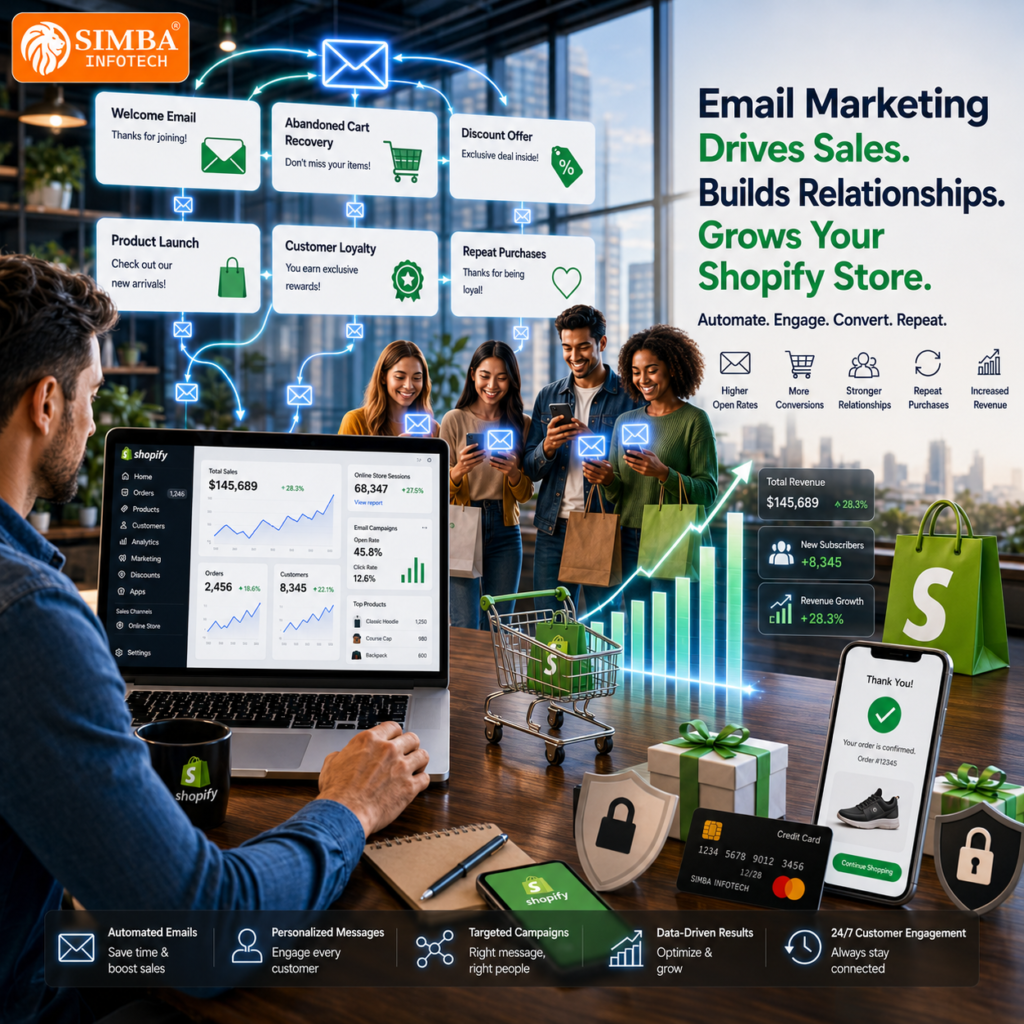
- Customer subscribes → enters welcome series
- Customer browses products but doesn’t buy → abandoned cart emails sent
- Customer buys a dress → post-purchase emails sent
- After 30 days → win-back email sent
This complete system runs automatically and becomes your full Digital marketing engine.
Conclusion
Email marketing is not just a simple communication tool; it is a powerful long-term growth system for Shopify stores. When you use it strategically, it becomes one of the most reliable ways to generate consistent traffic, increase sales, and build a loyal customer base over time.
Instead of depending only on paid ads or social media reach, email marketing gives you direct access to your customers. This allows you to build stronger relationships, improve engagement, and increase customer lifetime value in a structured way.
By applying strategies such as automation, segmentation, personalization, abandoned cart emails, post-purchase follow-ups, and win-back campaigns, you can significantly improve your overall revenue. Each of these strategies works together to create a complete and scalable marketing system that runs continuously in the background of your Shopify business.
FAQs
1. Is email marketing still effective for Shopify stores?
Yes, it is one of the most effective Digital marketing channels for increasing sales and customer retention.
2. How often should I send emails?
2–4 emails per week is ideal depending on your audience behavior.
3. What is the best tool for email marketing?
Klaviyo and Mailchimp are popular tools for Shopify stores.
4. Can small Shopify stores use email marketing?
Yes, even small stores can grow quickly using proper Digital marketing strategies.
5. What is the most important email strategy?
Abandoned cart emails and welcome series usually give the highest results.