- 07/06/2026
- Simba Infotech
- 0
Introduction
Have you ever spent hours tweaking your Facebook ads, only to watch your budget disappear? You change the budget here. You swap an image there. Yet, your sales stay the same.
If you are still managing your Meta ads by hand, you are fighting a losing battle.
The digital advertising world has changed. Today, the most successful brands do not rely on human guesswork. They use automation.
This guide will teach you why manual ad management is costing you money. You will learn how to switch to an autonomous ad account to scale your business faster.
What Is an Autonomous Ad Account?
Before we talk about losing money, let’s define what an autonomous ad account actually is.
Definition of Ad Automation
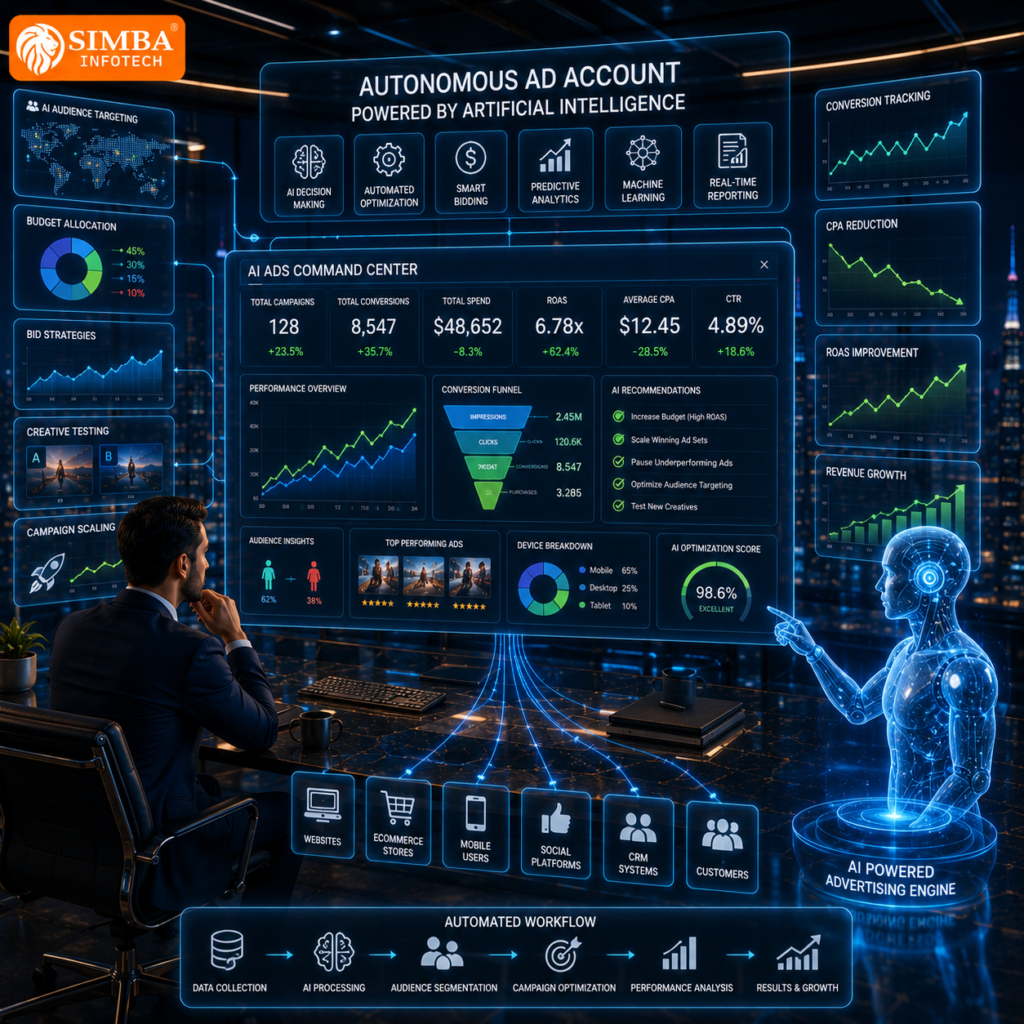
An autonomous ad account uses artificial intelligence (AI) and machine learning to run your campaigns. Instead of a human making every single decision, the Meta system does the heavy lifting. You set the goals, the budget, and the creative assets. The AI decides who sees the ad and when.
Automation vs. Manual Management
- Manual Management: You choose the exact audience, placement, and bid amount. You look at data and make changes every day.
- Autonomous Management: You give Meta multiple images, headlines, and videos. Meta’s algorithm tests combinations automatically to find the winners.
The Hidden Costs of Manual Meta Ad Management
Many business owners think manual control keeps their budget safe. The opposite is true. Micro-managing your ads creates leaks in your wallet.
The Human Brain Is Too Slow
Meta processes billions of data points every second. A human cannot look at a spreadsheet and compete with that speed. By the time you notice an ad is failing, you have already wasted money.
The Problem with Constant Tweaking
When you edit a campaign manually, you reset Meta’s learning phase.
- Every budget change pauses optimization.
- Every audience tweak confuses the system.
- You end up paying more for clicks because your account never stabilizes.
Audience Overlap and Fatigue
When you create multiple manual sets, you often target the same people twice. This is called audience overlap. You end up bidding against yourself. This drives your costs up and makes your audience tired of your brand.
Why Meta’s Algorithm Is Smarter Than You (And That Is a Good Thing)
It is hard to hand over control to a machine. But Meta’s AI has access to information you will never see.
Tracking Deep User Behavior
Meta does not just look at likes and comments. The system tracks how long someone hovers over an image. It knows what time of day a user is most likely to buy a product. Manual targeting cannot touch this level of detail.
Instant Optimization
If a specific video performs well at 2:00 AM, the algorithm shifts budget there instantly. A human media buyer is asleep at 2:00 AM. Automation ensures your money always goes to the best-performing asset in real-time.
Core Features of an Autonomous Ad Account
To build an autonomous account, you need to use Meta’s built-in smart tools. These tools make up the foundation of automated success.
Advantage+ Shopping Campaigns (ASC)
This is Meta’s flagship automation tool for e-commerce. You do not choose interests or demographics. You simply input your website and your creative assets. Meta finds the buyers for you.
- Benefit 1: Setup takes five minutes.
- Benefit 2: It automatically balances budget between new and returning customers.
Advantage+ Creative
You upload your raw images and text. Meta then automatically tweaks them for each user.
- It adjusts brightness and contrast.
- It swaps headlines based on user preference.
- It turns still images into short videos.
Advantage+ Audience
Instead of forcing Meta to look only at a specific group, you give it a “suggestion.” The AI uses your suggestion as a starting point. If it finds better buyers outside of that group, it expands the reach automatically.
Step-by-Step Guide to Setting Up an Autonomous Account
Moving away from manual management requires a structural shift. Follow this simple framework to rebuild your account for maximum profit.
Step 1: Clean Up Your Account Structure
Stop running 20 different campaigns. Collapse your account into a simple framework.
- Run one Advantage+ Shopping Campaign for sales.
- Run one broad targeting campaign for lead generation.
- Keep your budget consolidated to feed the algorithm data.
Step 2: Focus on Creative Quantity and Quality
In an autonomous account, your creative is your targeting. The hook in your video dictates who stops scrolling.
- Upload 3 to 5 completely different ad angles.
- Use user-generated content (UGC), high-quality product shots, and text-heavy images.
- Let Meta figure out which creative appeals to which audience segment.
Step 3: Define Clear Business Goals
The AI only works well if you give it the right instructions.
- Do not optimize for “clicks” if you want “purchases.”
- Set your optimization event to the deepest funnel action possible.
- Give the pixel accurate data by installing the Conversions API.
How to Analyze Data When the Machine Rules
An autonomous account does not mean you never look at your dashboard. It just changes what you look at. Stop looking at cost-per-click (CPC) and start looking at big-picture metrics.
Focus on Ecosystem ROAS
Return on Ad Spend (ROAS) inside Meta can be inaccurate due to privacy tracking changes. Look at your overall store revenue divided by your total ad spend. This is your True North metric.
Monitor Creative Fatigue
Keep an eye on your frequency metric. If the average person has seen your ad five times and sales are dropping, it is time to refresh your images and videos. Do not change the campaign settings; just add new creatives.
Common Myths About Ad Automation
Many marketers resist automation because of bad information. Let’s bust the most common myths.
Myth 1: “I Will Lose Control of My Brand”
You still control the images, the videos, and the words. The AI only controls who sees them. Your brand identity remains perfectly safe.
Myth 2: “Automation Wastes Money on the Wrong People”
The algorithm wants to generate cheap conversions for you. If it spends money on a specific group, it is because the data shows a high probability of a sale. Trust the math over your intuition.
The Ultimate Comparison: Manual vs. Autonomous Management
Understanding the direct differences between these two methods helps clarify why manual management drains your budget. They differ completely in setup time, budget efficiency, scaling capability, and daily focus.
Setup Time and Workflow
Manual management requires hours of audience research and interest targeting before you even launch. You have to build complex ad sets for every tiny demographic group. Autonomous management takes just minutes because you only upload your creative assets and text. The system skips the tedious setup and goes straight to testing.
Budget Efficiency and Optimization
Manual budgets lose efficiency because human buyers cannot track real-time performance drops. You often experience heavy audience overlap and constantly reset the critical learning phase. Autonomous systems offer high efficiency by shifting your money to winning ads every second. The AI prevents you from bidding against your own campaigns.
Scaling Capability
Scaling manually is a difficult process that requires complex math and cautious budget increments. If you raise a manual budget too fast, the performance usually crashes. Autonomous scaling is simple and predictable. You just increase the daily budget, and the machine distributes the weight safely across your best assets.
Your Main Daily Focus
Manual management forces you to spend your days tweaking toggles, setting bid caps, and reading micro-metrics. It turns you into a data-entry worker. Autonomous management shifts your focus entirely to marketing strategy. Your only job is to create better videos, write stronger copy, and improve your product offer.