- 07/04/2026
- Simba Infotech
- 0
Introduction
In today’s online world, your website is not just a digital identity—it is your strongest business asset. If you are doing business online or offering services, your website should work like a 24/7 sales machine that keeps bringing new leads even when you are sleeping.
This is where Digital marketing becomes essential for driving traffic, generating leads, and growing your business online. Without effective Digital marketing, your website remains only a digital brochure with no real results. But with the right strategy, your website can become a powerful system that attracts visitors, builds trust, and converts them into paying customers.
A well-optimized website should actively attract visitors, generate leads, and support your business goals.
In this blog, you will learn step-by-step how to transform your website into a high-converting lead generation machine using modern Digital marketing strategies. You will also see real-life examples so you can easily apply everything to your own business.
What is a Lead Generation Website?
A lead generation website is a professionally designed website that focuses on one primary goal turning your visitors into potential customers (leads). Instead of just providing information, it actively guides users to take action, helping your business grow consistently. In simple terms, your website should not only attract traffic but also convert that traffic into real business opportunities through effective Digital marketing strategies.
A lead generation website encourages users to connect with your business in different ways, such as:
- Making a phone call directly to your business
- Filling out a contact or inquiry form
- Sending a WhatsApp or direct message
- Booking an appointment or consultation
- Subscribing to newsletters for updates and offers
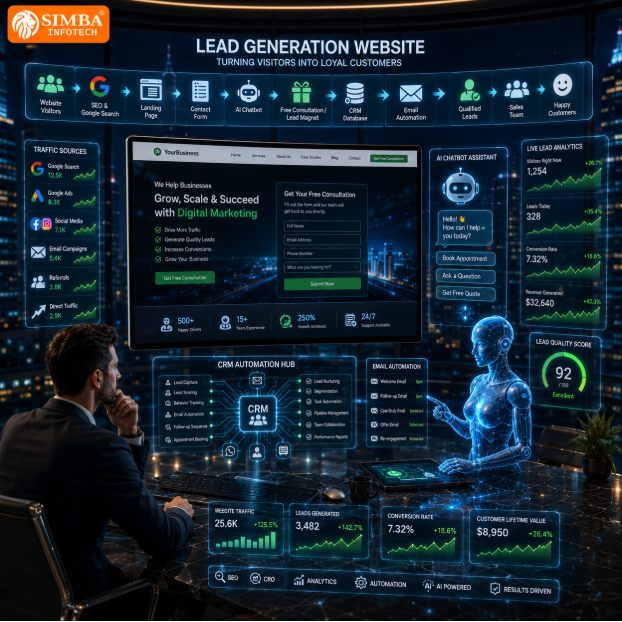
Each of these actions represents a valuable lead that can turn into a paying customer.
In Digital marketing, lead generation is considered the backbone of online success. High website traffic is useless if it does not turn into meaningful leads. That’s why every business website must be optimized with clear call-to-actions, trust signals, and conversion-focused design.
Ultimately, if your website is not generating leads, it means your Digital marketing strategy is incomplete and needs improvement.
Why Most Websites Fail to Generate Leads
Many business owners think that having a website alone is enough to attract customers. However, in reality, a website without strategy and optimization does not generate results. In today’s competitive online space, your website must be supported by strong Digital marketing practices to convert visitors into leads. Without that, even high traffic will not bring meaningful business growth.
Below are the key reasons why most websites fail to generate leads effectively:
1. No Clear Message
Your website should clearly communicate its offer and benefits the moment a visitor lands on it. Unfortunately, many websites fail to communicate their value clearly. If your message is confusing or too generic, users will leave within seconds. A strong message is a key part of effective Digital marketing because it builds instant clarity and interest.
2. Weak Design
A well-structured website design helps build trust and credibility among users. If your website looks outdated, unorganized, or unprofessional, visitors may hesitate to engage with your business. Good design is not just about looks—it is about user experience. In Digital marketing, design directly impacts conversion rates because people trust visually professional websites more.
3. No Proper Strategy
Many websites are built without a clear strategy or defined business goal. They do not follow a structured funnel or customer journey. Without a proper Digital marketing strategy, your website becomes just an online brochure instead of a lead-generating system. Strategy ensures that every page has a purpose and guides users toward conversion.
4. No Call-to-Action (CTA)
A Call-to-Action tells users what to do next—such as “Contact Us,” “Get a Quote,” or “Book a Call.” If your website does not guide users clearly, they will leave without taking action. Strong CTAs are essential in Digital marketing because they convert passive visitors into active leads.
5. No SEO Optimization
SEO is the key foundation that helps increase online visibility and boosts your website’s ranking in search results. Without SEO, your website will not appear on search engines, which means no organic traffic. Without traffic, generating leads becomes impossible. SEO is a key component of Digital marketing that ensures your website connects with the right audience when they are searching online.
In conclusion, most websites fail not due to poor products or services, but because they lack a clear structure, strategy, and Digital marketing optimization.
Step 1: Create a Clear Value Proposition
Your website must clearly communicate its purpose within a few seconds of a visitor landing on it. A clear value proposition allows users to instantly know what you provide, who benefits from it, and why you are the better choice. This is a foundational element of effective Digital marketing, as it directly influences user engagement and conversion rates.
To build a clear value proposition, your website should answer these three important questions:
- What do you offer?
- Who is your service or product for?
- What makes your business stand out from competitors in the market?
When these questions are answered clearly, visitors feel more confident and are more likely to stay on your website and take action. In Digital marketing, clarity is one of the most powerful tools for increasing conversions. If users are confused, they will leave your website without exploring further.

Example:
Weak message:
“We provide digital solutions.”
Strong message:
“We help small businesses expand their online presence using effective Digital marketing strategies that bring real leads and increase revenue.”
The difference is clear. The second message directly communicates value, target audience, and benefit. When your message is simple, direct, and focused on results, your Digital marketing performance improves significantly. A strong value proposition builds trust, improves engagement, and increases the chances of turning visitors into potential leads.
Step 2: Optimize Your Website for SEO
Search Engine Optimization (SEO) is a key pillar of strong Digital marketing performance. It helps your website appear on search engines like Google when users search for your products or services. If your website is not ranking on search results, you are missing out on a large number of potential leads every single day.
SEO ensures that your website gets visible to the right audience at the right time. When implemented correctly, it becomes one of the most powerful tools in Digital marketing for long-term growth and consistent traffic.
To improve your website’s SEO performance, you should focus on the following key areas:
- Keyword optimization: Use relevant keywords naturally in your content so search engines understand your website topic.
- Meta titles and descriptions: Write compelling and optimized meta tags to improve click-through rates.
- Blog writing: Publish high-quality, informative blogs regularly to attract organic traffic.
- Internal linking: Connect your pages to improve navigation and help search engines crawl your site effectively.
- Fast loading speed: Ensure your website loads quickly to improve user experience and search rankings.
When you combine SEO with a strong Digital marketing strategy, your website begins to attract free, high-quality organic traffic. This traffic is highly valuable because it consists of users actively searching for your services or solutions.
Step 3: Design a High-Converting Homepage
Your homepage acts as the digital front door of your business. It is the first page most visitors see, and it plays a major role in deciding whether they stay on your website or leave within seconds. In effective Digital marketing, your homepage must be designed with a clear focus on user experience and conversions.
A high-converting homepage should immediately communicate your value and guide visitors toward taking action. It is not just about design, but about clarity, speed, and purpose.
A good homepage should include the following elements:
- Be simple and clean: Avoid unnecessary clutter and keep the layout easy to understand.
- Load fast: A slow website reduces user trust and increases bounce rates.
- Show clear CTA buttons: Guide users with actions like “Contact Us,” “Get Quote,” or “Learn More.”
- Explain your service in 5 seconds: Your headline and intro should quickly tell visitors what you offer and how it helps them.
In Digital marketing, first impressions are extremely important. Users decide within seconds whether they trust your website or not. If your homepage is confusing, slow, or unclear, visitors will leave without exploring further.
A well-structured homepage improves engagement, builds trust, and increases conversions. It acts as the foundation of your entire Digital marketing strategy by turning visitors into potential leads from the very first interaction.
Step 4: Use Strong Call-to-Actions (CTAs)
A Call-to-Action (CTA) is one of the most important elements of your website because it guides users toward taking the next step. Without clear CTAs, visitors may browse your website but leave without engaging or contacting you. In effective Digital marketing, CTAs play a direct role in converting traffic into actual leads.
Your website should always tell users what to do next in a simple and clear way. Strong CTAs reduce confusion and increase conversion rates by encouraging visitors to take action immediately.
Some examples of strong and effective CTAs include:
- Get Free Consultation
- Book a Call Now
- Download Free Guide
- Start Your Project
- Request a Free Quote
Each of these CTAs is designed to attract attention and encourage user interaction. In Digital marketing, the goal is not just to get visitors but to turn those visitors into potential customers.
Placement of CTAs is equally important for better performance. You should strategically place them in key areas of your website such as:
- At the top section of your homepage for immediate visibility
- Inside blog posts to capture engaged readers
- On service pages where users are already interested in your offerings
- At the end of each page to encourage final action
When used correctly, CTAs act as conversion triggers in your Digital marketing strategy. They help guide users through your website journey and increase the chances of generating leads consistently.
Step 5: Build High-Converting Landing Pages
Landing pages are focused web pages created with a single objective—turning visitors into leads or customers. Unlike a homepage that provides general information, a landing page is designed to drive one specific action. In Digital marketing, landing pages play a very important role in improving conversion rates and campaign performance.
These pages are commonly used in different Digital marketing strategies such as Google Ads campaigns, Facebook and Instagram ads, email marketing campaigns, and SEO-based targeted traffic. Since visitors come with a specific intent, landing pages help you deliver exactly what they are looking for without distractions.
A high-converting landing page should include a few essential elements:
- One clear and focused offer that solves a user problem
- A single Call-to-Action (CTA) that guides users to take action
- A simple, clean design without unnecessary links or clutter
- Clear customer benefits that explain why the offer is valuable
In Digital marketing, the success of a landing page depends on how well it matches user intent. If a visitor clicks an ad or search result, they expect a direct solution. A well-structured landing page delivers that solution quickly and clearly.
When optimized properly, landing pages help you generate more leads, improve user experience, and make your Digital marketing efforts more profitable and result-driven.
Step 6: Add Trust Elements to Your Website
Trust is one of the most important factors that influence whether a visitor becomes a lead or leaves your website. People do not take action unless they feel confident about your business. In Digital marketing, building trust is essential because it directly impacts conversion rates and customer decisions.
To improve trust on your website, you should include strong credibility-building elements that show your experience, results, and reliability.
You can build trust using the following elements:
- Client testimonials that show real customer experiences
- Google reviews that highlight your business reputation
- Case studies that demonstrate successful projects and results
- Portfolio showcasing your past work and achievements
- Certifications and awards that prove your expertise
Each of these elements helps reduce doubt and increase confidence in your services. In Digital marketing, trust signals act as proof that your business is genuine and capable of delivering results.
Without trust, even high-quality traffic will not convert into leads. Visitors may explore your website, but they will hesitate to take action if they do not feel secure.
Step 7: Create High-Quality Content (Blog Strategy)
Content is the foundation of every successful online business. In fact, it is often called the heart of Digital marketing because it helps you attract, educate, and convert your audience over time. If you want long-term and consistent leads, you must focus on creating valuable and relevant content for your users.
High-quality content helps you build trust and position your business as an expert in your industry. It also improves your website visibility on search engines, which is a key goal in Digital marketing.
You should focus on creating different types of content such as:
- Blogs that answer user questions and solve problems
- Detailed guides that explain topics step-by-step
- Case studies that show real results and success stories
- FAQs that address common customer doubts
When you publish useful and informative content regularly, your Digital marketing performance improves in multiple ways.
Firstly, you start getting more organic traffic from search engines as your content ranks for relevant keywords. Secondly, you build authority in your niche, which increases trust among your audience. Lastly, you attract highly targeted users who are actively searching for your services.
Consistent content creation ensures that your website stays active, relevant, and valuable. Over time, this strengthens your Digital marketing strategy and helps you generate more qualified leads.
Step 8: Use Lead Capture Forms
Lead capture forms are an essential part of any successful website because they help you collect important user information and convert visitors into potential leads. In Digital marketing, these forms act as a direct connection between your business and interested users.
A well-designed lead capture form should always be simple and easy to fill. The more complex the form, the lower the chances of conversion. Users prefer quick and hassle-free interactions, especially when they are browsing online.
To improve conversions, you should keep your form fields minimal, such as:
- Name
- Email address
- Phone number
Avoid asking for unnecessary details at the first stage, as long forms often discourage users from completing the process. In Digital marketing, simplicity plays a key role in increasing engagement and lead generation.
When your lead capture forms are short, clear, and strategically placed on your website, you increase the chances of turning visitors into real business opportunities.
Step 9: Improve Website Speed and Mobile Experience
Website speed and mobile experience play a crucial role in how users interact with your site. In today’s digital world, most visitors expect a website to load quickly and work smoothly on all devices. If your site is slow or not mobile-friendly, users will leave immediately, which directly affects your conversions and growth in Digital marketing.
A fast and responsive website not only improves user experience but also helps you perform better on search engines like Google. That means better visibility and more organic traffic from your Digital marketing efforts.
To improve your website speed and mobile experience, you should focus on the following actions:
- Compress images to reduce file size without losing quality
- Use fast and reliable hosting for better performance
- Optimize mobile design so your website works smoothly on all screen sizes
- Reduce unnecessary scripts and plugins that slow down loading time
Google also considers website speed as a ranking factor. This means faster websites are more likely to appear higher in search results, which strengthens your Digital marketing performance. A well-optimized website keeps users engaged, reduces bounce rates, and increases the chances of turning visitors into leads and customers.
Step 10: Use Email Marketing Automation
Email marketing is one of the most powerful and reliable tools in Digital marketing. It allows you to stay connected with your audience even after they leave your website. Once you collect leads through forms or landing pages, email automation helps you nurture those leads and convert them into paying customers over time.
Instead of manually following up with every lead, automation helps you send the right message at the right time. This makes your communication more effective and saves a lot of time.
With email marketing automation, you can:
- Send welcome emails to new subscribers and introduce your business
- Share special offers, discounts, or service updates
- Educate users through helpful tips, guides, and blog content
- Build long-term relationships by staying consistent in communication
In Digital marketing, email marketing is important because it keeps your brand in front of potential customers. Many users may not convert immediately, but regular emails help build trust and encourage future action.
Step 11: Use Social Media to Drive Traffic
Social media platforms like Instagram, Facebook, and LinkedIn play a powerful role in strengthening your Digital marketing strategy. These platforms help you reach a wider audience, increase brand visibility, and drive targeted traffic to your website.
By consistently using social media, you can connect with potential customers and guide them toward your services or content. It is not just about posting content, but about creating meaningful engagement that supports your Digital marketing goals.
You can effectively use social media to:
- Share your blog posts and website content to attract visitors
- Run paid ads to target specific audiences and generate leads
- Build strong brand awareness and trust among users
- Send consistent traffic to your website for higher conversions
When social media marketing is combined with your website strategy, it creates a powerful Digital marketing system. Social media attracts attention, and your website converts that attention into leads and customers.
Step 12: Track Everything with Analytics
Tracking your website performance is very important if you want to grow your business online. Without proper tracking, you cannot understand what is working and what needs improvement. In Digital marketing, analytics helps you make smart, data-driven decisions that improve results over time.
Using the right tools allows you to clearly see how users interact with your website, where they come from, and what actions they take. This helps you optimize your strategy and increase conversions effectively.
Key Tools You Should Use:
- Google Analytics
- Google Search Console
What You Can Track:
- Visitor behavior and user journey on your website
- Conversion rate (how many visitors become leads)
- Traffic sources such as Google, social media, or ads
In Digital marketing, tracking performance is the foundation of continuous improvement. When you analyze real data, you can identify strengths and fix weaknesses in your website and campaigns. By consistently monitoring analytics, you can improve user experience, boost engagement, and turn more visitors into potential customers.
Conclusion
Turning your website into a powerful lead generation machine is not complicated, but it does require a clear and consistent strategy. When you properly apply Digital marketing techniques, your website becomes more than just an online presence—it becomes a system that actively brings you business opportunities.
By focusing on key areas like SEO, content creation, landing pages, strong CTAs, and automation, you can transform your website into a platform that works for you 24/7. These Digital marketing elements work together to attract the right audience, engage them, and convert them into potential customers.
The most important thing to understand is:
- A website without Digital marketing is just a digital page with no real purpose
- A website with Digital marketing is a complete business system that generates leads and sales consistently
If you take action step by step and keep improving your strategy, your website will start delivering consistent leads every day. Over time, it will become one of your most valuable business assets, helping you grow faster and more efficiently.
Key Takeaways
- A website becomes powerful only with a strong Digital marketing strategy.
- SEO helps your website get free and consistent traffic.
- Clear messaging and strong CTAs increase conversions.
- Landing pages improve lead generation results.
- Trust elements build credibility and user confidence.
- Quality content drives long-term Digital marketing success.
- Simple forms and fast websites improve user experience.
- Email marketing helps convert leads into customers.
- Social media brings targeted traffic to your website.
- Analytics help you track and improve performance.
- A well-optimized website works as a 24/7 lead generation system.
FAQ (Frequently Asked Questions)
1. What is a lead generation website?
A website that converts visitors into leads using forms, CTAs, and Digital marketing strategies.
2. How does Digital marketing help in lead generation?
It helps bring traffic, build trust, and convert visitors into customers.
3. Do I need SEO for lead generation?
Yes, SEO is a core part of Digital marketing and helps you get organic traffic.
4. What is the best way to get leads online?
Using a mix of SEO, landing pages, ads, and Digital marketing content.
5. Can small businesses use this strategy?
Yes, even small businesses can use Digital marketing to generate consistent leads.