
- 06/12/2026
- Simba Infotech
- 0
Introduction
Marketing lessons do not always come from boardrooms, business books, or people wearing blazers and saying “synergy” with full confidence.
Sometimes, they come from potatoes. Sometimes, from iron jewelry. And sometimes, from a tire company that somehow became famous for restaurants.
Sounds weird, right? Still, please be with me and read these 3 amazing marketing stories which should be known by marketers like you, and still it is fine if you are from a non-marketing background because it is so funny that you won’t make you breathless but definitely make you smile or laugh.
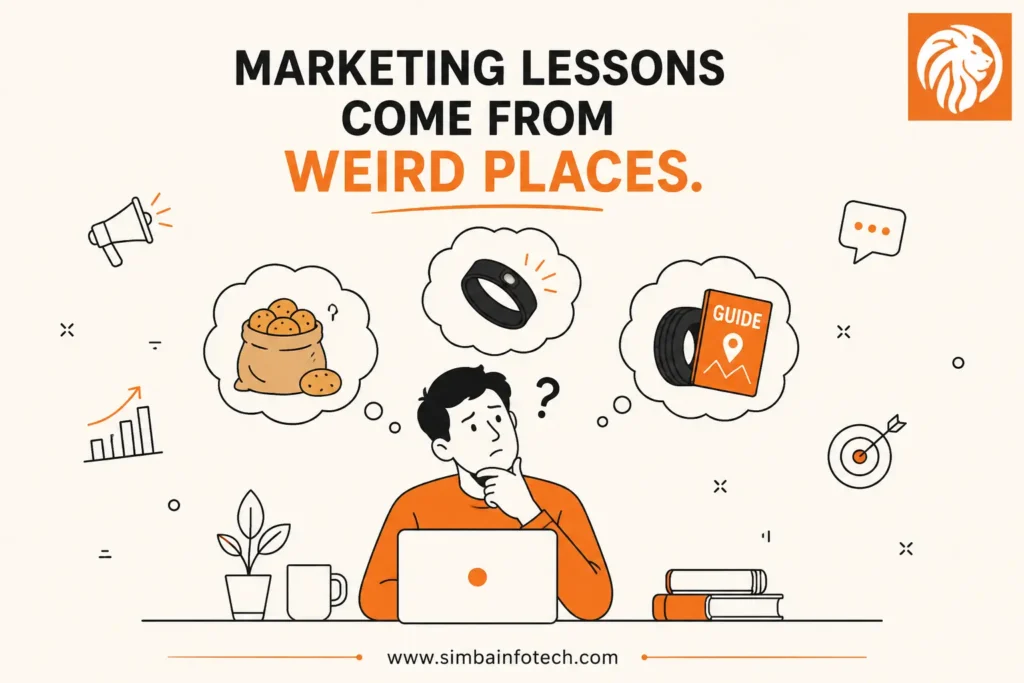
Honestly, whenever I say this to my friends or colleagues, they look at me like I have either discovered a secret marketing formula or completely lost the plot. Most of them laugh first, because potatoes, iron, and tires do not exactly sound like serious marketing material.
Most businesses today think marketing means running ads, posting on social media, ranking on Google, or hiring a digital marketing agency to bring more leads. All of that matters, of course. But before tools, platforms, and dashboards, marketing was already helping people solve one timeless problem: how do you make others care?
That is exactly what these three stories teach.
One story shows how people learned to accept something they did not trust. Another shows how ordinary iron became more meaningful than gold. The third shows how Michelin made tires interesting without talking much about tires, which is honestly impressive because tires are not exactly dinner-table gossip.
Together, these stories prove that great marketing is not only about promotion. It is about creating meaning, building demand, and making people see value where they previously saw nothing special.
So, before we talk about algorithms, campaigns, or content calendars, let us look at three unusual marketing stories that are funny, clever, and surprisingly useful for modern marketers.
Story 1: How Germans Learned to Love Potatoes
Let us start with a very serious marketing object.
Potato.
Yes, the same potato that becomes fries, chips, wedges, aloo sabzi, and that one extra samosa filling we never complain about.
Today, we all know potatoes. Nobody is scared of them. Nobody sees a potato and says, “No bro, this vegetable looks dangerous.”
But many years ago, in parts of Europe, people were not so happy about eating potatoes. They did not understand it. They did not trust it. It grew under the ground, looked dirty, and did not feel like normal food to them.
So here was the problem.
The potato was useful. It could feed people. is great source of carbs, very cheap than bread and also, It could help during food shortages.
But people still did not want it.
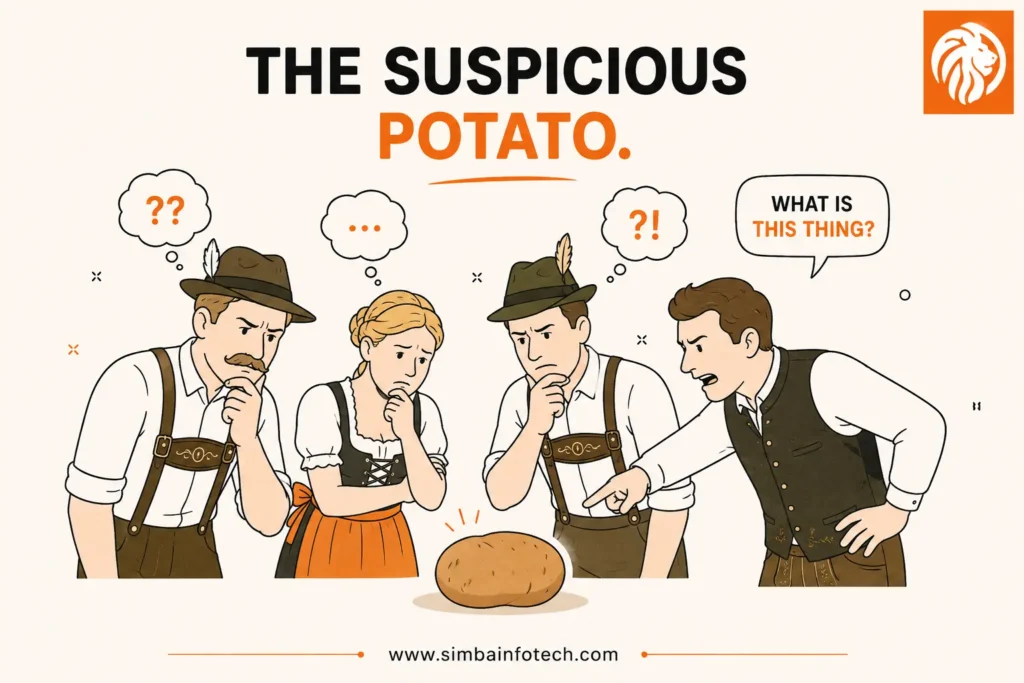
And this is where the story becomes interesting.
Rory Sutherland talks about this potato story in his book Alchemy. The idea is simple but powerful: people do not always value something because of facts. Many times, they value something because of the way it is presented.
According to the famous story, Frederick the Great, the king of Prussia, wanted people to grow and eat potatoes. But when he told people to do it, they were not interested.
Now, most leaders would probably give a speech.
- “Potatoes are good for you.”
- “Potatoes will help the country.”
- “Please eat potatoes.”
Very boring. Very government-notice-board energy. But heres a catch Frederick did something smarter. Which was absurd , funny but really effective The story says he planted potato fields and asked soldiers to guard them.
Now think from the farmer’s side.
Yesterday, nobody cared about potatoes.
Today, soldiers are standing near potato fields. Of course, people became curious. They must have thought, “Wait a minute. Why is the king guarding these potatoes? Are these special? Are rich people eating them? Is this some royal food?”
And slowly, people started stealing potatoes from the fields.
That sounds funny, but it is also very smart.
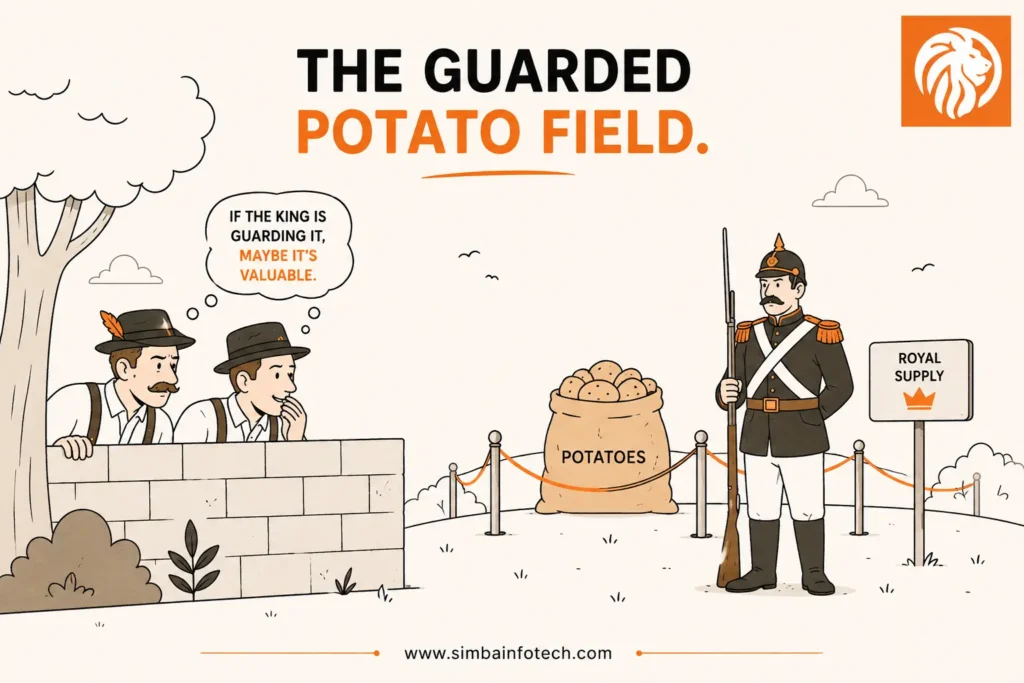
Frederick did not make a long lecture about potato benefits. He made potatoes look valuable. Same potato. Same taste. Same dirt.
just Different meaning. and different presentation
That is the marketing lesson.
Many times, people do not reject a product because the product is bad. They reject it because they do not understand its value yet. A business may have a good product, but if the customer sees it as normal, boring, risky, or confusing, they will ignore it.
That same problem exists even today.
A company may say, “We provide digital marketing services,” but many business owners will think, “Okay… but why should I care?” A social media agency may say, “We create content,” and the client may quietly wonder, “Can’t my cousin also make posts on Canva?” An SEO company may say, “We improve rankings,” and the customer is still thinking, “Fine… but when will I get leads?”
So the issue is not always the service itself. Many times, it is how people see it. He literally just made people to feel potatoes are rare and valueable
That is what makes this potato story interesting. Frederick did not change the potato. The potato stayed exactly the same. What changed was how people looked at it. And once that changed, everything else followed.
Suddenly, the same thing people ignored started feeling important. Not because it was new, but because it felt different.
And that is where things start to get interesting for marketing.
Story 2: How Prussia Turned Iron Into Gold
Now let us move from potatoes to something even stranger.
Iron.
Yes, plain iron. Not gold, not diamond, not some luxury thing that comes in a velvet box and makes people suddenly speak softly.
Just iron.
Usually, when people compare iron and gold, gold wins without even trying. Gold is shiny, expensive, and has that “rich uncle at a wedding” energy. Iron, on the other hand, is strong and useful, but nobody normally looks at it and says, “Wow, this feels priceless.”
But Prussia once managed to make iron feel more valuable than gold.
Sounds impossible, right?
This story comes from the time of the Napoleonic Wars. In the early 1800s, Prussia was fighting against Napoleon, and war was expensive. Very expensive. Armies needed money, weapons, supplies, and resources. The government needed precious metals like gold and silver to support the war effort.
Now, asking people for money is never easy.
Even today, if someone says, “Please give your gold for the country,” most people will suddenly become very busy checking their phone.
But Prussia did something interesting.
The royal family asked citizens to give their gold and silver jewelry to help fund the war. In return, people received jewelry made from iron. According to sources on Berlin iron jewelry, this became especially popular around 1813 to 1815, during the War of Liberation against Napoleon. Many of these iron pieces carried the German phrase “Gold gab ich für Eisen,” which means “I gave gold for iron.”
Just think about that for a second.
Someone gave away real gold.
In return, they got iron.
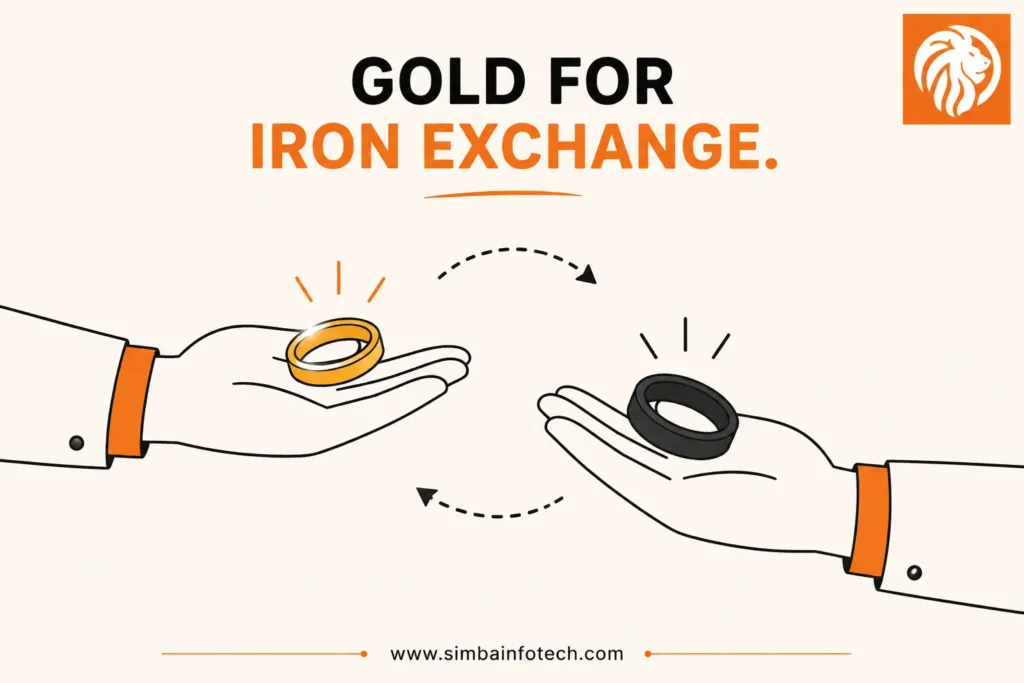
Normally, that sounds like the worst exchange offer in history. Imagine going to a shop and saying, “Here is my gold ring,” and the shopkeeper says, “Amazing, sir. Please take this iron ring.” You would probably call your lawyer, your family, and maybe even your astrologer. But in Prussia, people wore those iron rings and brooches with pride.
Why?
- Because that iron jewelry was not just jewelry anymore. It became proof.
- Proof that the person had sacrificed something valuable.
- Proof that they had helped the country.
Proof that they were loyal, patriotic, and part of something bigger than themselves.
So suddenly, iron did not feel cheap. It felt honorable.
A gold ring said, “I have wealth.”
An iron ring said, “I gave my wealth for my country.”
That is a very different kind of status. And people valued that second status more than i have wealth one
And honestly, it is a little funny because the cheaper material started carrying the bigger meaning. Gold was still gold. It was still expensive. It was still shiny. But in that moment, wearing iron could say something more powerful about a person.
The design also helped. These iron pieces were not ugly metal chunks that looked like someone broke a gate and made jewelry from it. Berlin iron jewelry was often delicate, detailed, and carefully made. Some pieces had fine patterns, black finishing, and beautiful shapes. They were made to be worn, not hidden in a drawer with old bills and broken chargers.
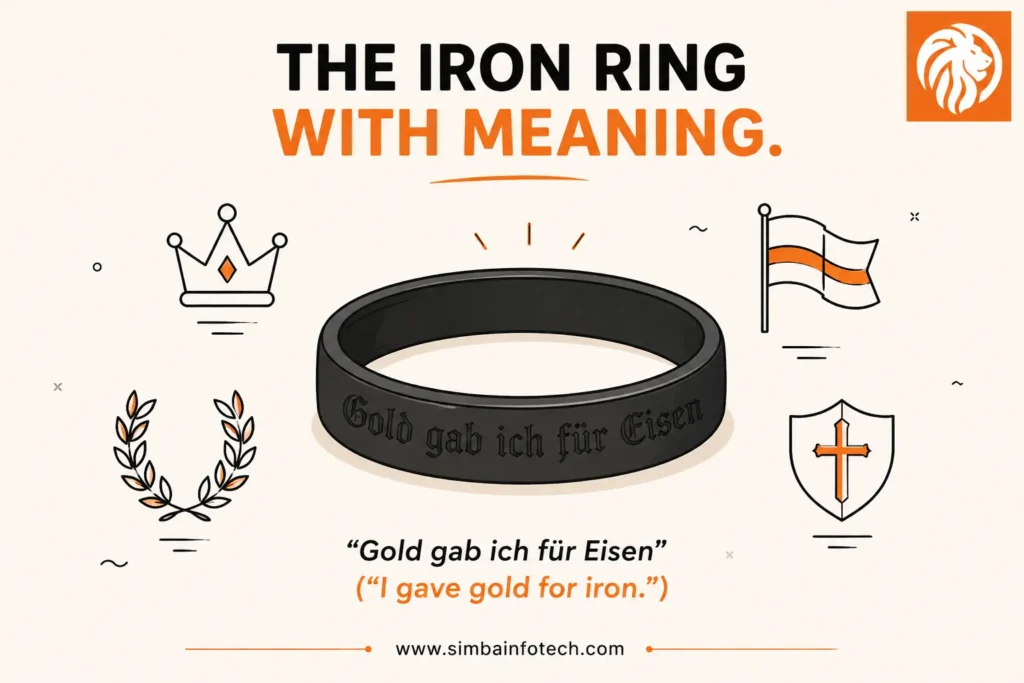
Sources like the Gemological Institute of America also mention that many Berlin iron jewelry pieces were engraved with “Gold gab ich für Eisen 1813.” The phrase became part of the object itself. So when someone wore the jewelry, they were not only wearing iron. They were wearing a story.
That is the most interesting part because the object was simple, though the story was powerful and, and without the story, it was just iron. With the story, it became a symbol. And once something becomes a symbol, people do not look at it the same way anymore.
This is why the story feels so strange and brilliant at the same time. Prussia did not make iron physically more valuable than gold. That would be actual alchemy, and sadly, nobody found the cheat code for that. But socially, emotionally, and publicly, iron became something special.
People could wear it and show, without giving a long speech, “I contributed. I sacrificed. I stood with my country.” That small piece of iron carried a big message And that is why the phrase “I gave gold for iron” is still remembered today. It was not just about metal. It was about what the metal represented.
So yes, Prussia did not literally turn iron into gold. But for a short moment in history, it made iron feel more meaningful than gold. Which is honestly a pretty impressive thing to do. Isn’t it?
Story 3: How Michelin Made Tires Interesting Without Talking About Tires
Now comes one of my favorite stories.
Because honestly, how do you make tires interesting?
No disrespect to tires. They are useful. They are important. They keep the car moving. They stop us from having a very dramatic day on the road.
But let us be honest.
Most people do not wake up in the morning and say, “Today, I really want to read something exciting about rubber.”
Tires are one of those products people remember only when there is a problem. When the tire is flat. When the car is shaking. When the mechanic says, “Sir, this needs replacement,” and suddenly your monthly budget starts crying quietly.
Michelin had this problem too.
Michelin was a tire company. André and Édouard Michelin founded the company in Clermont-Ferrand, France, in 1889. At that time, cars were still very new. According to the official Michelin Guide history, there were fewer than 3,000 cars in France when the Michelin brothers started thinking about the future of automobiles.
Now think about that.
Fewer than 3,000 cars in the whole country. Today, some parking areas in malls feel like they have more cars than that.
So Michelin had a strange business problem. They were selling tires, but not enough people were driving yet. And if people did not drive much, tires would not wear out. If tires did not wear out, people would not buy new tires.
So it was a simple, boring, and costly problem. Most companies would have said, “Let us run ads saying our tires are strong.” Michelin did something much smarter. They created a guide that was not about tires, but it was about travel.
In 1900, the Michelin brothers published the first Michelin Guide. According to Michelin’s official history, the guide was made for motorists and included useful information such as maps, hotels, restaurants, fuel stations, mechanics, and tire-changing instructions.
Basically, Michelin said, “Here, take this guide. Go out. Drive. Explore. Eat. Stay somewhere. Discover places.”
Very smooth.
They were not standing in front of people shouting, “Buy tires! Buy tires!” Instead, they were giving people more reasons to use their cars. And once people used their cars more, tires naturally became more important. That is the beautiful part of this story.
Michelin did not try to make tires exciting. They made the journey exciting.
- A tire by itself is not very romantic but A road trip is.
- A tire by itself is not a weekend plan while A nice restaurant in another town can be.
- A tire by itself is not a dream. Travel, food, hotels, and freedom are.
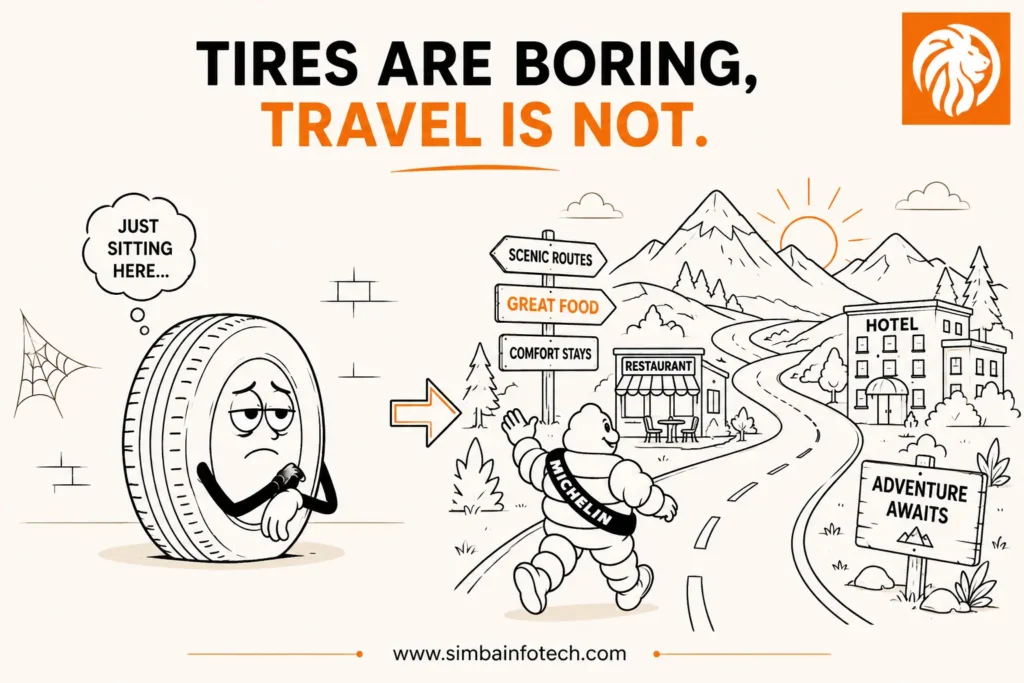
So Michelin moved the attention away from the product and toward the world around the product.
That is why the Michelin Guide became such a big deal.
At first, the guide was practical. It helped drivers know where to go, where to eat, where to sleep, where to get fuel, and where to repair the car if something went wrong. This was very important at that time because driving was not as easy as it is today. There was no Google Maps. No “petrol pump near me.” No food blogger saying, “Guys, this hidden café is a must-visit.”
Drivers needed help.
Michelin gave them that help.
Slowly, the guide became more famous. It started reviewing restaurants. Later, it became known for Michelin stars, which are now among the most respected awards in the food world. A restaurant getting a Michelin star is a huge thing. Chefs celebrate it, customers talk about it, and food lovers suddenly start planning trips around it.
Just imagine that.
A tire company created something that became one of the biggest names in fine dining That is almost funny. It is like a ceiling fan company becoming the biggest authority on poetry. Anyways Michelin did it and it was way beyond what anyone can think it. The best part is, the whole idea started from a very practical business need: get people to drive more.
- More driving meant more tire use.
- More tire use meant more tire sales.
- More travel meant Michelin became part of the journey, not just part of the vehicle.
According to the official Michelin Guide history, the guide was created to support the growth of car travel, and it later became a trusted reference for restaurants and hotels. What started as a simple travel guide became a cultural icon.
Today, many people know Michelin because of restaurants, not because of tires.
That is wild.
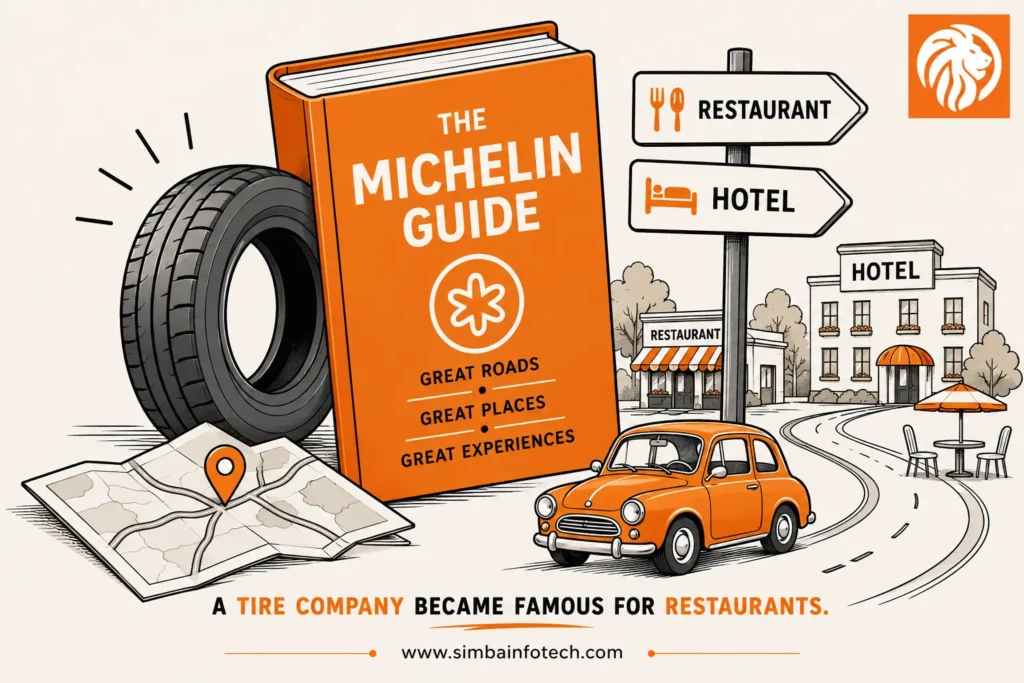
A company that made rubber tires became a name people connect with luxury dining, travel, taste, and high standards. Michelin did not force people to care about tires. They helped people care about where tires could take them And honestly, that is a much better conversation.
Because nobody wants to talk about tire rubber for fun. But everyone loves talking about good food, beautiful places, weekend trips, and that one restaurant where the bill made them question all their life choices.
The Boring but Helpful Part: What These Stories Teach Marketers
Now that we are done talking about potatoes, iron, and tires, let us come to the part every marketer secretly waits for.
The lesson.
Yes, this is the slightly boring part. But helpful. Like eating salad after ordering pizza. Not exciting, but probably necessary.
These three stories look very different from each other. One is about food. One is about jewelry. One is about a tire company that somehow entered the restaurant world like it had a reservation.
But all three stories are connected by one simple thing: people did not care at first. People did not care about potatoes. People normally would not care more about iron than gold. People definitely did not care about reading long love letters to tires.
Something had to change before people started paying attention. And that is where marketing enters.
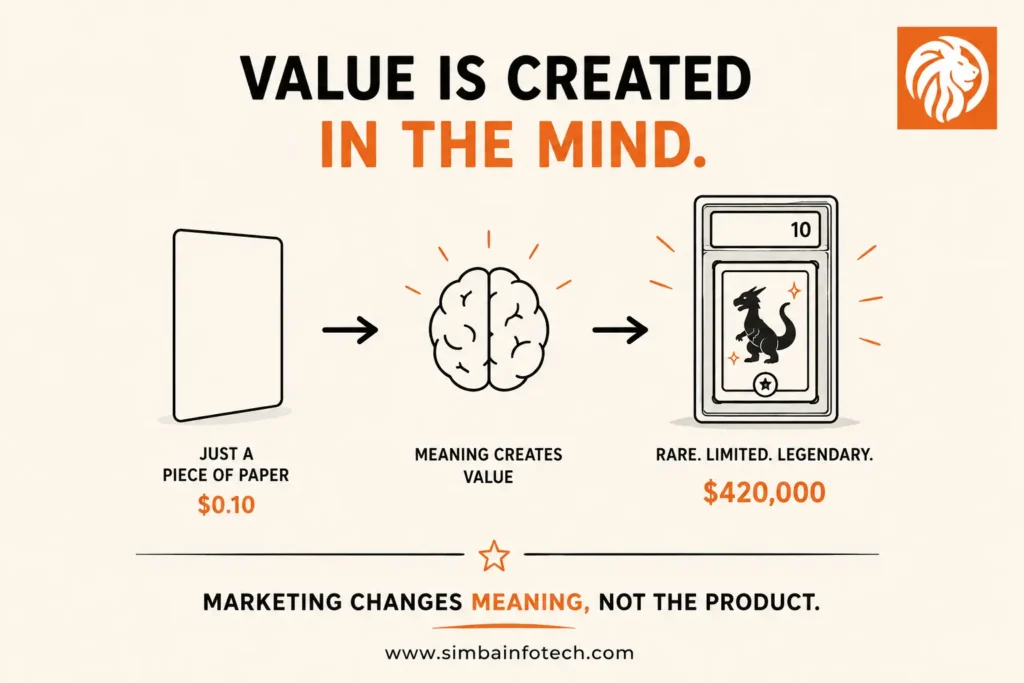
The first lesson is that people do not always reject something because it is bad. Many times, they reject it because they do not understand it yet. Potatoes were useful, cheap, and helpful during food shortages, but people still ignored them.
Why? Because they looked strange, felt unfamiliar, and did not have trust attached to them. In other words they just had negative emotional response towards potatoes.
The same thing happens in business today. A good service can still be ignored if people do not understand why it matters or they just dont feel any good about it. A good product can still struggle if customers do not know how it fits into their life.
This is where education becomes important. Before selling, sometimes a brand has to explain.
Before asking people to buy, sometimes a brand has to help them feel safe. A digital marketing agency in surat, for example, cannot only say, “We provide digital marketing services.”
Many business owners have already heard that line 500 times. They need to understand what good marketing actually changes for their business, whether that is better visibility, better leads, stronger trust, or fewer random posts made just because “today is Monday, so we should post something.”
The second lesson is that value is not only about material or features. Iron was cheaper than gold. Everyone knew that. Nobody in Prussia suddenly forgot basic common sense.
But when iron became connected with sacrifice, pride, and patriotism, it started carrying a different kind of value. The object was ordinary, but the meaning became powerful.
Modern brands deal with the same thing every day. Two products can be almost the same, but people may still choose one over the other because of what it represents. A plain T-shirt can become a fashion statement.
A simple café can become a “vibe.” A phone can become a status symbol. A local business can become trusted not only because of what it sells, but because of how it makes people feel.
Just consider the 500rs note , right, we do value it because it is in our mind and also accepted by the society that with this 500 rs you can buy whatever goods but what if it doesn’t hold any value in the mind of society members gonna be piece of paper thats why we can use that note here in india but not in other part of the world.
That is why branding matters. A branding agency or a social media marketing agency cannot only focus on colors, captions, and designs. Those things are important, but they are not the full story. The bigger job is to help people understand what the brand stands for. Because when meaning is strong, the product stops being just another option in the market.
The third lesson is that boring products do not always need boring marketing. Michelin did not try to make people fall in love with tire rubber. That would have been a difficult romance. Instead, Michelin made people care about travel, restaurants, hotels, roads, and discovery. The company talked about the world around the product, not only the product itself.
This is very useful for modern content marketing. Many businesses think they have nothing interesting to say because their product is not “exciting.” But the product does not always need to be the main character.
Sometimes the customer’s problem is the main character. Sometimes the lifestyle around the product is the main character. Sometimes the result people want is the main character.
A furniture company does not only need to talk about chairs. It can talk about better workspaces, back pain, office comfort, productivity, and how people can stop sitting like a folded bedsheet. A gym equipment company does not only need to talk about machines.
It can talk about fitness habits, discipline, home workouts, and health goals. An SEO company in Surat does not only need to talk about rankings. It can talk about how customers search, how trust is built on Google, and why being invisible online is not a business strategy.
That is the real power of content. It gives people a reason to care before they are ready to buy.
The fourth lesson is that marketing is not only about demand capture. It is also about demand creation. Demand capture means reaching people who already know they need something. For example, someone searches “best digital marketing agency in Surat” because they already know they need help. That is important, of course. But demand creation is different. It means helping people realize they have a problem, an opportunity, or a desire they had not clearly thought about before.
Michelin did this beautifully. Instead of only waiting for people to need tires, it encouraged people to drive more. More driving created more need for tires. That is almost Blue Ocean thinking before people started using fancy words for it. Michelin did not only fight inside the tire category. It made the whole driving experience more attractive.
A modern business can learn a lot from that. Instead of only chasing people who are ready to buy today, create content for people who are still learning, thinking, comparing, and slowly becoming aware of the problem. That is how a brand builds trust before the sales conversation even begins.
The fifth lesson is that presentation can change attention. Frederick’s potato did not become a different potato. Prussian iron did not become a different metal. Michelin tires did not suddenly become exciting dinner conversation. But the way each thing was presented changed how people responded.
That is exactly why marketing cannot be treated like decoration. Marketing is not just “make one poster” or “post something on Instagram.” Good marketing changes the frame. It helps people see the product, service, or brand in a better context.
So yes, the stories are funny. Potato stealing is funny. Giving gold and receiving iron sounds like the worst exchange offer ever. A tire company becoming famous for restaurants is also very strange.
But behind all that weirdness, there is a serious point.
People do not only buy what something is.
They buy what it means, what it helps them do, what it says about them, and how clearly they understand its value.
That is why marketers should study stories like these. Not because we all need to start guarding potato fields or selling iron jewelry tomorrow. Please do not do that. Ahmedabad already has enough traffic problems; we do not need guarded potato farms also.
The point is simpler.
If people do not care, do not only shout louder.
Change the way they see it.
Conclusion
So yes, this whole blog started with potatoes, iron, and tires.
Not exactly the usual “serious marketing” material.
But maybe that is the point.
Marketing is often treated like a very complicated thing. People make it sound like you need ten tools, five dashboards, three strategy calls, and one person who says “funnel” every 12 minutes.
Those things can help, of course. But at its heart, marketing is still very simple.
It is about making people care.
A potato became interesting when people saw it differently. Iron became powerful when it carried a bigger meaning. Tires became part of travel, food, freedom, and discovery.
That is why these stories are still worth reading today. They remind us that good marketing does not always begin with a campaign. Sometimes, it begins with a better way of looking at the same thing.
And that is something every marketer, business owner, social media agency, branding agency, SEO company, or digital marketing agency should remember.
Before asking people to buy, ask yourself one thing: Have we given them a reason to care? Or does it have enough meaning to make people take action? Because once people care, marketing becomes much easier. And if they do not care, even the best-looking poster is just decoration with confidence.
Key Takeways
1. Great marketing is about making people care, not just promoting products or services.
2. People may reject a product because they do not understand its value yet, not because the product is bad.
3. Presentation can completely change perception, like potatoes becoming desirable when they appeared rare and important.
4. Meaning can be more powerful than material value, as shown by iron jewelry becoming a symbol of sacrifice and pride.
5. Branding is not just design or captions; it is about what the brand represents in people’s minds.
6. Boring products can still have interesting marketing when the focus shifts to the customer’s lifestyle, problem, or desired outcome.
7. is not only demand capture; it is also demand creation, helping people realize why they need something before they actively search for it.
Frequently Asked Questions
Why are marketing stories important for digital marketing?
Marketing stories are important because they make digital marketing more human and memorable. Today, brands use SEO, social media marketing, content marketing, online advertising, and branding to reach customers, but people still connect better with stories than plain sales messages. A good story helps explain why a product matters, how it solves a problem, and why people should care about it. That is why storytelling is useful in almost every part of online marketing.
What can marketers learn from famous marketing stories?
Marketers can learn that successful marketing is not only about running ads or posting content online. Famous marketing stories teach us how perception, emotion, trust, and meaning can change the way people see a product. Whether it is traditional marketing or digital marketing, the main goal is the same: help people understand value. These stories show that a strong message can make even ordinary products feel important, useful, or desirable.
How does storytelling help in content marketing and branding?
Storytelling helps content marketing and branding by giving a product or service a deeper meaning. Instead of only talking about features, brands can use stories to show values, emotions, customer problems, and real-life benefits. This makes blog content, social media posts, video marketing, email marketing, and website copy more engaging. A strong brand story can also help customers remember the business and trust it more.
What is the role of perception in digital marketing?
Perception plays a very important role in digital marketing because customers do not always buy the best product; they often buy the product they understand, trust, and value the most. SEO, social media marketing, paid advertising, branding, and content strategy all help shape how people see a business online. If a product is presented as useful, meaningful, or different, people are more likely to pay attention and take action.
How can businesses use marketing stories to create demand?
Businesses can use marketing stories to create demand by helping people realize why they need a product or service before they actively search for it. This is useful in digital marketing, inbound marketing, content creation, brand building, and social media campaigns. Instead of only targeting customers who are ready to buy, brands can create blogs, videos, case studies, and educational content that build interest early. Good storytelling makes people care first, and once they care, selling becomes easier.