- 06/11/2026
- Simba Infotech
- 0
Introduction
Running a business today involves handling countless tasks every day. You need to manage customer inquiries, respond to emails, update records, create invoices, schedule appointments, track sales, and market your products or services. As your business grows, these responsibilities increase, making it difficult to focus on activities that truly drive growth. This is where business automation becomes valuable.
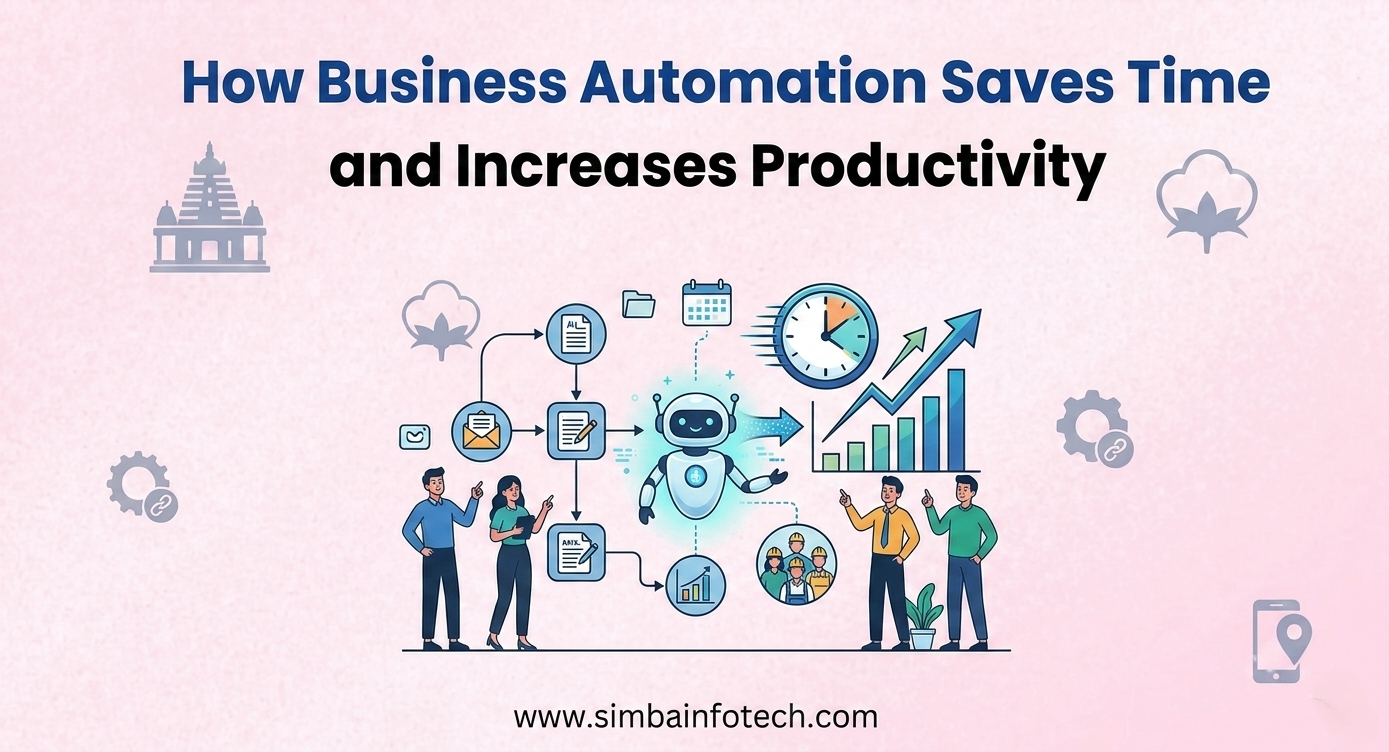
Business automation helps you streamline repetitive tasks using software, tools, and technology. Instead of spending hours manually performing routine activities, automation allows systems to handle them automatically. This saves time, reduces errors, improves efficiency, and helps your team focus on more important work.
Whether you run a startup, small business, eCommerce store, or large company, automation can transform how you operate. Combined with effective Digital Marketing strategies, automation helps businesses generate more leads, improve customer experiences, and achieve sustainable growth.
In this guide, you will learn:
- What business automation is
- Why automation is important
- Types of business automation
- How automation saves time
- How automation boosts productivity
- Major Benefits of Business Automation
- How automation works with Digital Marketing
- Real-life implementation examples
What Is Business Automation?
Business automation refers to using technology and software to perform repetitive business tasks without constant human involvement. Instead of manually completing the same task repeatedly, you create automated workflows that handle the process for you.
For example:
- Sending welcome emails automatically
- Creating invoices automatically
- Updating customer records automatically
- Scheduling social media posts automatically
- Generating reports automatically
- Assigning tasks automatically
Business automation does not replace people. Rather than replacing employees, business automation helps them work more efficiently, reduce repetitive tasks, and focus on activities that drive business growth.
Many businesses combine automation with Digital Marketing strategies to streamline lead management, strengthen customer relationships, and improve sales efficiency.
Why Business Automation Is Becoming Essential
The modern business environment moves quickly. Today’s customers expect quick responses, exceptional service, and a seamless experience at every stage of their interaction with your business.
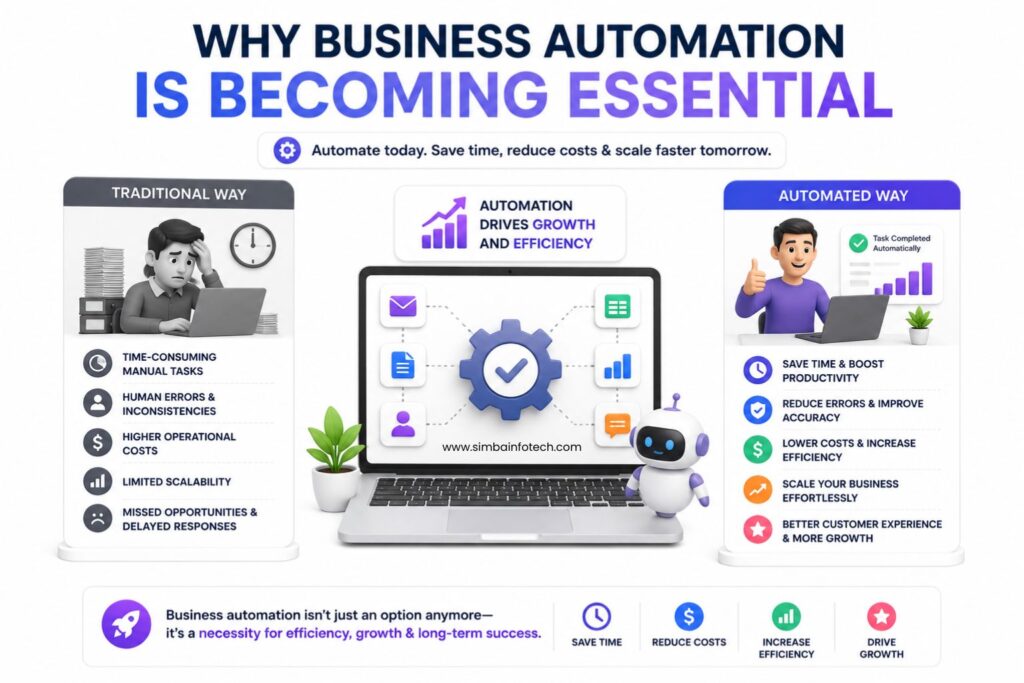
If you continue relying only on manual processes, you may face:
- Missed opportunities
- Human errors
- Slow response times
- Lower productivity
- Increased operating costs
Automation helps solve these problems.
Key Reasons Businesses Adopt Automation
- Saves valuable time
- Improves workflow efficiency
- Reduces repetitive work
- Minimizes mistakes
- Enhances customer experience
- Supports business growth
- Improves team productivity
Automation and Digital Marketing work together to simplify lead management, improve customer engagement, and support long-term business growth.
Types of Business Automation
Different departments can benefit from automation.
1. Marketing Automation
Marketing automation helps businesses manage customer interactions and marketing activities more efficiently. Instead of manually handling every campaign, businesses can automate repetitive marketing tasks and maintain consistent communication with their audience.
Some common examples of marketing automation include:
- Email marketing campaigns
- Lead nurturing workflows
- Social media scheduling
- Customer segmentation
- Campaign performance tracking
Many businesses combine marketing automation with Digital Marketing strategies to attract, engage, and convert potential customers more effectively. By delivering the right message at the right time, marketing automation helps improve customer relationships and increase conversion rates.
Benefits of Marketing Automation
- Better lead management
- Higher customer engagement
- Improved customer experience
- Increased sales opportunities
- More efficient Digital Marketing campaigns
2. Sales Automation
Sales automation helps sales teams work more efficiently by reducing the time spent on repetitive administrative tasks. It allows sales professionals to focus on building relationships and closing deals rather than managing paperwork and manual follow-ups.
Businesses can automate tasks such as:
- Lead tracking and management
- Proposal and quotation generation
- Follow-up email sequences
- Customer communication
- Sales pipeline updates
Sales automation works closely with Digital Marketing efforts by ensuring that leads generated through marketing campaigns are properly tracked and nurtured throughout the sales process. This creates a smoother customer journey and improves conversion rates.
Benefits of Sales Automation
- Faster lead response times
- Improved sales productivity
- Better lead conversion rates
- Enhanced customer communication
- More organized sales processes
3. Customer Service Automation
Providing excellent customer support is essential for business success, but managing large volumes of inquiries can be challenging. Customer service automation helps businesses deliver faster and more consistent support without increasing workload.
Common customer service automation tools include:
- AI-powered chatbots
- Help desk systems
- Ticket management software
- Automated email responses
- Self-service support portals
These solutions help customers receive answers quickly while allowing support teams to focus on more complex issues.
Benefits of Customer Service Automation
- Faster customer support
- Improved customer satisfaction
- Reduced workload for support teams
- Consistent service quality
- Better customer retention
When integrated with Digital Marketing, customer service automation can also improve customer engagement and strengthen brand loyalty.
4. Financial Automation
Financial management involves numerous repetitive and detail-oriented tasks. Financial automation helps businesses handle these processes more accurately and efficiently while reducing the risk of human error.
Businesses can automate activities such as:
- Invoice generation
- Expense tracking
- Payroll processing
- Financial reporting
- Payment reminders
By automating financial operations, businesses can save significant administrative time and ensure greater accuracy in their records.
Benefits of Financial Automation
- Reduced administrative workload
- Improved financial accuracy
- Faster reporting and analysis
- Better cash flow management
- Increased compliance and record keeping
Financial automation allows business owners and managers to spend less time on paperwork and more time focusing on growth opportunities.
5. HR Automation
Human Resources departments often manage large amounts of employee information and administrative processes. HR automation helps simplify these responsibilities while improving employee experiences.
Common HR automation functions include:
- Employee onboarding
- Attendance and time tracking
- Leave management
- Performance evaluations
- Employee record management
By automating routine HR tasks, organizations can improve efficiency and allow HR professionals to focus on employee development, training, and workplace culture.
Benefits of HR Automation
- Faster onboarding processes
- Improved employee record management
- Reduced administrative work
- Better compliance and documentation
- More focus on employee growth and engagement
As businesses continue to grow, HR automation becomes increasingly valuable for maintaining organized and efficient workforce management.
How Business Automation Saves Time
Eliminates Repetitive Tasks
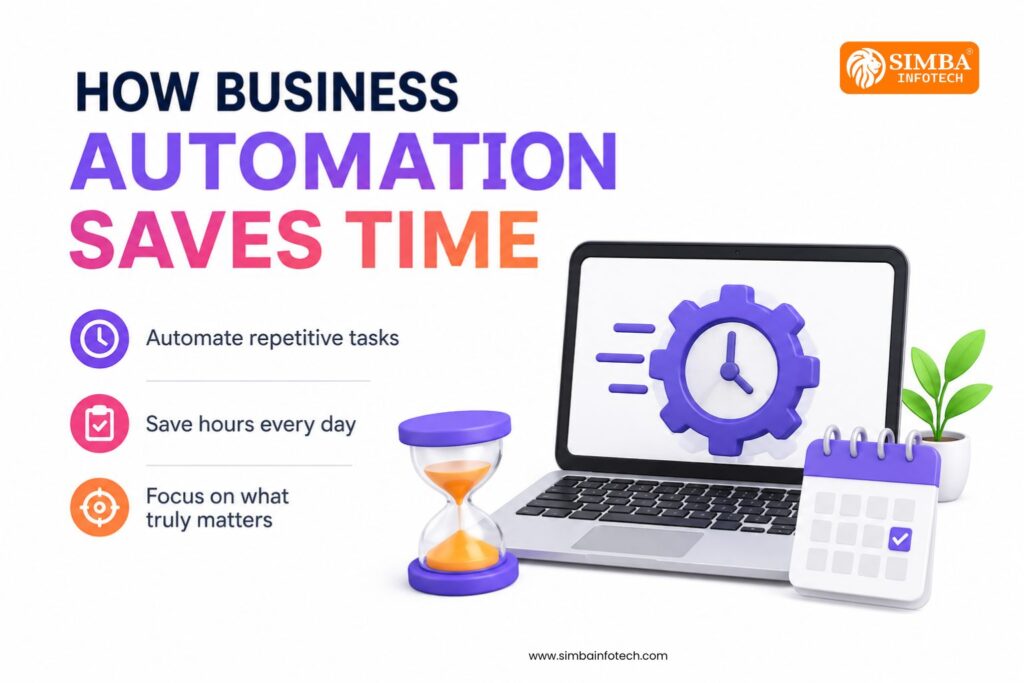
Many daily business operations involve repetitive tasks that require significant time and effort. While these tasks are important, performing them manually every day can reduce overall productivity and slow down business operations.
Common repetitive tasks include:
- Data entry
- Email follow-ups
- Appointment reminders
- Inventory updates
- Report generation
Business automation can handle these activities automatically, reducing the need for manual involvement. Tasks that might normally take hours to complete can often be performed within minutes or even seconds through automated workflows.
Businesses that integrate automation into their Digital Marketing strategies can also automate lead nurturing, email communication, and customer engagement activities, saving considerable time while maintaining consistent communication.
Speeds Up Communication
Fast and effective communication is essential for providing excellent customer service and maintaining strong business relationships. Customers often expect quick responses and timely updates throughout their interactions with a business.
Automation helps businesses communicate more efficiently by enabling them to:
- Send instant replies
- Provide chat support
- Confirm appointments automatically
- Deliver notifications and updates
- Respond to inquiries around the clock
Automated communication systems ensure that messages are delivered promptly without requiring constant manual effort. This not only saves time but also improves customer satisfaction by providing quicker responses and a smoother experience.
Many businesses use automation alongside Digital Marketing campaigns to ensure that customers and prospects receive relevant information at the right time without delays.
Simplifies Data Management
Managing large amounts of business data manually can be both time-consuming and challenging. As customer information, sales records, marketing data, and operational reports continue to grow, organizing and maintaining this information becomes increasingly difficult.
Business automation simplifies data management by automatically:
- Collecting information
- Organizing records
- Updating databases
- Generating reports
- Maintaining accurate data
Instead of spending hours searching for information or manually updating records, businesses can access organized and accurate data whenever needed. This helps teams work more efficiently and supports faster decision-making.
Automation is especially valuable when monitoring Digital Marketing performance, customer behavior, and campaign results, as reports and insights can be generated automatically.
Reduces Manual Follow-Ups
Following up with customers, leads, and prospects is an important part of business operations. However, manually managing follow-up activities can consume significant time and may lead to delays or missed opportunities.
Business automation helps streamline follow-up processes by automatically:
- Sending reminders
- Following up after purchases
- Requesting customer reviews
- Sharing promotional offers
- Re-engaging inactive customers
Automated follow-up systems ensure that communication remains consistent and timely without requiring ongoing manual effort. This helps businesses maintain stronger customer relationships while reducing administrative workload.
Businesses using automated Digital Marketing funnels can nurture leads throughout the customer journey and keep prospects engaged without constantly managing every interaction manually.
How Business Automation Boosts Productivity
Saving time is important, but productivity is equally valuable.
Automation helps your team accomplish more work with fewer resources.
Allows Employees to Focus on High-Value Tasks
Employees often spend a significant amount of time on repetitive administrative work that adds little strategic value to the business. While these tasks are necessary, they can prevent teams from focusing on activities that drive growth and innovation.
When routine processes are automated, employees can dedicate more time to important responsibilities such as:
- Problem-solving
- Building customer relationships
- Strategic planning
- Innovation and creativity
- Revenue-generating activities
Instead of spending hours on data entry, manual reporting, or repetitive communication, your team can focus on improving customer experiences, developing new opportunities, and strengthening your Digital Marketing efforts. This leads to higher productivity and better business outcomes.
Reduces Human Errors
Human errors are a common challenge in manual business processes. Mistakes can occur when employees are handling repetitive tasks, working under pressure, or managing large volumes of information.
Some common errors include:
- Entering incorrect data
- Missing deadlines
- Forgetting follow-ups
- Sending incomplete reports
- Updating records incorrectly
Business automation helps reduce these risks by performing tasks according to predefined rules and workflows. Automated systems follow the same process consistently, helping ensure greater accuracy and reliability.
Accurate information is essential for effective decision-making, operational efficiency, and successful Digital Marketing campaigns. By minimizing errors, businesses can improve overall productivity while maintaining higher standards of quality.
Improves Team Collaboration
Effective collaboration is essential for maintaining productivity, especially as businesses grow and teams become larger. Poor communication and lack of visibility can lead to confusion, duplicated efforts, and missed deadlines.
Automation platforms help improve collaboration by keeping team members informed and connected throughout business processes.
Employees can:
- Track tasks and responsibilities
- Share updates more efficiently
- Monitor project progress
- Receive real-time notifications
- Access centralized information
When everyone has access to the same information and workflows, teams can work together more effectively. Improved communication and transparency help reduce delays, increase accountability, and create a more productive work environment.
Supports Business Growth
As businesses grow, daily workloads naturally increase. Managing more customers, projects, and operations often requires additional time and resources. Without efficient systems in place, growth can create operational challenges and reduce productivity.
Business automation allows organizations to handle increased workloads without significantly increasing staffing requirements. Automated processes can scale alongside business operations, helping companies maintain efficiency even as demand grows.
Automation supports growth by:
- Managing larger volumes of work efficiently
- Streamlining business processes
- Reducing operational bottlenecks
- Improving resource utilization
- Maintaining consistent customer communication
Many businesses also expand their Digital Marketing activities through automation, allowing them to manage more leads, campaigns, and customer interactions while maintaining high levels of engagement and service quality.
Major Benefits of Business Automation
Increased Efficiency
One of the biggest advantages of business automation is increased efficiency. Manual processes often require significant time and effort, especially when the same tasks must be repeated every day. Automation handles these activities quickly and consistently, allowing work to be completed faster and with fewer delays. Whether it is processing customer inquiries, generating reports, or managing workflows, automation helps businesses operate more smoothly and efficiently.
Lower Operational Costs
Business automation can significantly reduce operational expenses. When routine tasks are automated, businesses spend less time and money on manual labor and repetitive administrative work. This allows organizations to allocate resources more effectively and focus on growth-oriented activities. Over time, reduced labor costs, fewer mistakes, and improved efficiency can lead to substantial cost savings.
Better Customer Experience
Customers expect quick responses and seamless interactions with businesses. Automation helps meet these expectations by providing instant replies, appointment reminders, order updates, and personalized communications. Faster service and improved consistency create a better customer experience, helping businesses build stronger relationships and increase customer satisfaction.
Higher Productivity
When employees no longer have to spend hours on repetitive tasks, they can focus on more valuable responsibilities such as problem-solving, innovation, customer engagement, and strategic planning. Automation removes unnecessary workload, allowing teams to accomplish more in less time. As a result, overall productivity improves across the organization.
Improved Accuracy
Human errors are common in manual processes, especially when dealing with large amounts of data or repetitive tasks. Automation reduces the risk of mistakes by following predefined rules and workflows consistently. Accurate data entry, reporting, invoicing, and customer management help businesses operate more reliably and maintain higher standards of quality.
Faster Decision Making
Successful businesses rely on accurate and timely information to make informed decisions. Automation tools can collect, organize, and analyze data in real time, providing valuable insights whenever needed. Instead of waiting for manually prepared reports, business leaders can access up-to-date information instantly, helping them make faster and more confident decisions.
Better Digital Marketing Results
Automation plays a major role in improving Digital Marketing performance. Businesses can automate email campaigns, social media scheduling, lead nurturing, customer segmentation, and performance reporting. This ensures that potential customers receive the right message at the right time without requiring constant manual effort. By improving campaign management and customer engagement, automation helps businesses generate more leads, increase conversions, and achieve better overall Digital Marketing results.
How to Start Business Automation
If you are new to automation, follow these steps.
Step 1: Identify Repetitive Tasks
Look for activities your team performs repeatedly.
Examples:
- Data entry
- Email responses
- Report creation
Step 2: Choose Automation Tools
Select tools that fit your needs and budget.
Step 3: Create Workflows
Design simple processes first.
Step 4: Test and Optimize
Monitor results and improve workflows.
Step 5: Expand Gradually
Automate additional processes over time.
Many businesses begin by automating Digital Marketing activities because they often deliver quick results.
Real-Life Example: How You Can Implement Business Automation
Imagine you own a home services company.
Without automation:
- A customer fills out a contact form.
- You manually check the email.
- You send a reply.
- You schedule a consultation.
- You follow up later.
This process takes significant time.
With Automation:
Step 1:
Customer submits a website form.
Step 2:
An automated email thanks them instantly.
Step 3:
Their information enters your CRM automatically.
Step 4:
A consultation link is sent automatically.
Step 5:
Reminder emails are scheduled automatically.
Step 6:
Follow-up messages are delivered automatically.
Step 7:
Performance reports are generated automatically.
Meanwhile, your Digital Marketing system continues nurturing leads through automated email sequences.
As a result:
- Faster response times
- Better customer experience
- More conversions
- Increased productivity
- Higher revenue
This is a practical example of how business automation and Digital Marketing work together.
The Future of Business Automation
Automation continues evolving rapidly.
Future trends include:
- AI-powered workflows
- Predictive analytics
- Smart customer support
- Personalized customer experiences
- Advanced Digital Marketing automation
- Automated business intelligence
Businesses that adopt automation early are often better positioned for long-term growth.
Conclusion
Business automation is no longer a luxury—it has become an essential tool for modern businesses. By automating repetitive tasks, you can save time, reduce errors, improve customer experiences, and increase productivity across your organization.
Whether you want to automate marketing, sales, customer service, finance, or operations, the benefits can be significant. When combined with effective Digital Marketing, automation helps you generate leads, nurture prospects, improve engagement, and scale your business more efficiently.
The best approach is to start small, automate your most repetitive tasks, and gradually expand your automation strategy. Over time, you will free up valuable resources, improve efficiency, and create more opportunities for business growth.
Key Takeaways
- Business automation saves time by handling repetitive tasks automatically.
- It improves productivity by allowing your team to focus on important work.
- Automation reduces human errors and increases efficiency.
- It helps businesses provide faster and better customer service.
- Marketing, sales, finance, and customer support processes can all be automated.
- Automation strengthens Digital Marketing efforts through lead nurturing, email marketing, and reporting.
- Businesses can scale operations more easily without significantly increasing costs.
- Starting with small automation projects can lead to significant long-term growth and efficiency improvements.
FAQs
1. What is business automation?
Ans: Business automation is the use of software and technology to perform repetitive business tasks automatically with minimal human involvement.
2. How does business automation save time?
Ans: Automation eliminates manual work, speeds up communication, automates reporting, and reduces repetitive administrative tasks.
3. Can small businesses benefit from automation?
Ans: Yes. Small businesses can improve efficiency, reduce costs, and increase productivity through automation.
4. How does automation help Digital Marketing?
Ans: Automation helps manage email campaigns, social media scheduling, lead nurturing, customer segmentation, and performance reporting.
5. Is business automation expensive?
Ans: Not necessarily. Many affordable automation tools are available for businesses of all sizes.
6.What should I automate first?
Ans: Start with repetitive tasks such as email responses, appointment scheduling, lead management, and reporting.